Tangle Toy: The Therapeutic Fidget That Sold 1 Million Units 2026
Alex Thompson
Author
How I Discovered the Tangle Toy
The first time I held a Tangle toy was in a hand therapist's office in the fall of 2019. I had fractured my scaphoid bone in a cycling accident and spent eight weeks in a cast. When the cast came off, my wrist was stiff, weak, and the muscles in my hand had atrophied noticeably. My occupational therapist handed me a small, brightly colored object made of interlocking curved pieces and said, "Twist this while we talk."
I was skeptical. It looked like a toy from a dentist's office waiting room. But within thirty seconds of twisting it between my fingers, something clicked. The motion was smooth, almost liquid. Each segment rotated independently, and there was no right way to hold it, no goal, no endpoint. I could twist it mindlessly for hours. My therapist told me the repetitive motion was helping rebuild the fine motor control in my injured hand, but what surprised me was how calming it felt. My shoulders dropped. My jaw unclenched. I stopped thinking about the pain in my wrist.
I bought my first Tangle Jr on the way home from that appointment. Six years later, I own fourteen different Tangle models and have given them to nearly everyone in my life. This is everything I have learned about this deceptively simple therapeutic tool.
The History of the Tangle Toy
Richard X. Zawitz and the Infinite Curve
The Tangle toy was born from art, not industry. Richard X. Zawitz, a sculptor born in Pittsburgh and raised in Hawaii, began exploring the concept of the infinite curve in the late 1970s. Zawitz was fascinated by Chinese puzzle balls, mathematical topology, and the visual representation of infinity. His early sculptures were large, intricate metal pieces that embodied the idea of a continuous, unbroken line.
In 1981, Zawitz created the first Tangle sculpture. It was a series of curved, interlocking metal segments that could be twisted and reshaped endlessly. The piece was displayed in galleries and quickly attracted attention for its unique combination of art, mathematics, and tactile appeal. People who encountered the sculpture could not stop touching it. Zawitz realized his art was not just meant to be looked at. It was meant to be held.
From Sculpture to Mass Market
Throughout the 1980s and 1990s, Zawitz refined his Tangle designs and began producing smaller versions for retail. The transition from fine art to consumer product was not overnight. Zawitz spent years developing manufacturing techniques that could replicate the smooth, satisfying rotation of his hand-made sculptures at scale. The challenge was maintaining the precise tolerances needed for each segment to pivot smoothly while keeping production costs accessible.
The modern Tangle toy hit mainstream retail in the early 2000s and quickly found an audience far beyond the art world. Occupational therapists discovered that the Tangle's continuous motion was ideal for hand rehabilitation, sensory processing, and stress management. Teachers found them useful for students who needed to fidget to focus. The toy sold over one million units and spawned an entire product line.
What makes the Tangle story remarkable is that it started as a personal artistic vision. Zawitz was not trying to create a fidget toy empire. He was trying to express the concept of infinity in physical form. The therapeutic applications were a natural consequence of the design's inherent properties: smooth motion, no sharp edges, no batteries, no noise, no beginning, and no end.
How the Tangle Toy Works
The Anatomy of a Tangle
Every Tangle toy follows the same basic structure: a series of curved, tubular segments connected by small joints that allow each piece to rotate independently. When you twist one segment, the motion transfers through the chain, creating a fluid, wave-like movement that can travel in any direction.
Each segment is roughly the shape of a quarter-circle arc. When connected in sequence, these arcs form a closed loop, a continuous ring with no starting point or end point. This is the "tangle" effect: the toy can be twisted, folded, and reconfigured into an infinite number of shapes, but it never comes apart and never reaches a final position.
The joints between segments use a simple ball-and-socket design. Each joint allows approximately 90 degrees of rotation, which gives the toy enough freedom to move smoothly without becoming floppy or uncontrolled. The resistance at each joint is calibrated to feel satisfying, not too tight, not too loose.
Why the Motion Feels So Good
There is a reason the Tangle has remained popular for decades while countless other fidget toys have come and gone. The twisting motion activates multiple sensory systems simultaneously.
Tactile feedback: Your fingers feel the smooth rotation of each joint and the texture of the surface material.
Proprioceptive input: The slight resistance in the joints provides gentle pressure feedback to the muscles and tendons in your hands.
Visual tracking: Watching the segments shift and reform engages your visual system in a low-demand way.
Repetitive rhythm: The continuous, cyclical motion creates a predictable pattern that the nervous system finds regulating.
This combination of sensory inputs is what makes the Tangle so effective as a calming tool. It gives your brain just enough stimulation to satisfy the urge to fidget without pulling your attention away from whatever you are doing.
The Tangle Product Lineup
Tangle Jr
The Tangle Jr is the entry point for most people and remains the best-selling model. It is the smallest version, measuring about 6 inches when straightened, and fits comfortably in one hand. The Jr is designed for children ages 3 and up, but plenty of adults prefer it for its portability and discreet size.
Tangle Jr comes in dozens of color combinations and several texture variations. The classic smooth plastic version is the most common, but there are also fuzzy, rubberized, and metallic finishes. The Jr typically retails for $4 to $8 depending on the finish and retailer.
Tangle Classic
The Tangle Classic is the standard adult-sized version, roughly 10 inches when straightened. The segments are slightly larger and easier to grip for adults with bigger hands. It has the same smooth twisting action as the Jr but feels more substantial in your hand.
The Classic is available in a wide range of colors and is often sold in multi-packs. It is the version most commonly found in therapy offices and classrooms. Retail price ranges from $6 to $12.
Tangle Therapy
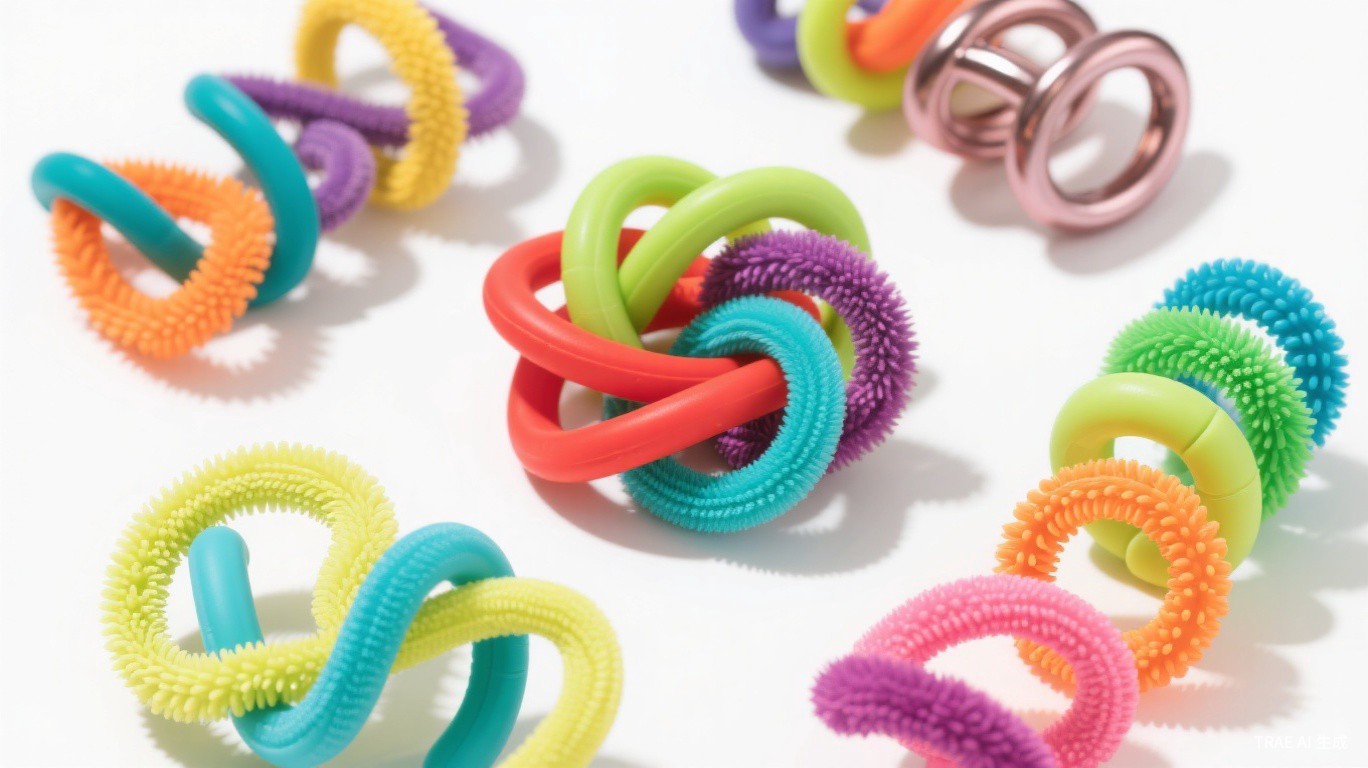
This is where the Tangle line gets serious. Tangle Therapy models feature a textured rubber surface that provides additional tactile stimulation. The rubber coating is soft, slightly tacky, and has raised bumps or ridges that add a massage-like element to the twisting motion.
Tangle Therapy is specifically designed for hand rehabilitation, arthritis management, and stress relief. The rubber texture makes it easier to grip for people with reduced hand strength, and the additional sensory input from the texture makes it more effective for people with sensory processing differences.
There are several Tangle Therapy variants:
- Tangle Therapy Relax: A softer, more flexible version with a smooth rubber surface designed for gentle hand exercise.
- Tangle Therapy Cre8: Features a harder rubber surface with more pronounced textures for stronger sensory feedback.
- Tangle Therapy Original: The standard therapeutic model with a balanced texture that works for most users.
Tangle Therapy models typically retail for $8 to $15.
Tangle Hairy
The Tangle Hairy is one of the more unusual variants. Each segment is covered in soft, rubbery "hair" or bristle-like protrusions that create a unique tactile experience. Running your fingers along the surface feels similar to stroking a soft brush or a fuzzy caterpillar.
This model is particularly popular with sensory seekers who crave tactile input. The bristles provide a scratching, stimulating sensation that smooth Tangles cannot replicate. Kids with autism and sensory processing disorder often gravitate toward this model.
Tangle Metallic
The Tangle Metallic line features a chrome or brushed metal finish that looks more like a piece of modern art than a fidget toy. These are the Tangles you can leave on your desk at work without anyone questioning your professionalism.
The metallic finish is smooth and cool to the touch, providing a different sensory experience than the standard plastic versions. They are slightly heavier, which some people prefer for the added proprioceptive feedback. Retail price is typically $8 to $14.
Therapeutic Applications
Occupational Therapy
Tangle toys are a staple in occupational therapy clinics worldwide. Therapists use them for hand strengthening, fine motor coordination, and range of motion exercises. The twisting action requires engagement from the fingers, wrists, and forearms, making it an effective tool for rehabilitation after hand injuries, strokes, or surgeries.
For children with developmental delays, the Tangle serves as both a strengthening tool and a reward. Kids enjoy manipulating it, so they are more willing to complete the repetitive exercises that therapy requires. Many OTs keep a collection of different Tangle models so children can choose the one that feels best to them.
Stress and Anxiety Management
The Tangle is one of the most portable anxiety tools available. It fits in a pocket, makes no noise, requires no setup, and can be used in any setting without drawing attention. The repetitive motion activates the parasympathetic nervous system, which helps counteract the fight-or-flight response that drives anxiety.
Therapists who specialize in anxiety disorders often recommend Tangles as part of a broader coping strategy. The toy serves as a grounding object, something physical to focus on when anxious thoughts start to spiral. Unlike phone-based anxiety apps, the Tangle does not require a screen, notifications, or battery life.
ADHD and Focus Support
For people with ADHD, the Tangle provides the mild sensory stimulation that the brain needs to maintain focus. Research in this area suggests that controlled fidgeting can actually improve attention and working memory in individuals with ADHD by increasing arousal levels to the optimal range for cognitive performance.
The Tangle is particularly effective for this purpose because it is silent, low-profile, and does not require visual attention. You can twist it under your desk during a meeting or lecture without anyone noticing, and the motion is rhythmic enough to be regulating without being distracting.
Creativity and Thinking
Writers, artists, and designers frequently report that fidgeting with a Tangle helps them think more creatively. The theory is that occupying the motor and sensory systems with a simple, repetitive task frees up cognitive resources for higher-order thinking. The Tangle does not demand problem-solving or decision-making. It just moves, and your hands follow.
I keep a Tangle Metallic on my desk specifically for this purpose. When I am stuck on a piece of writing, I pick it up and twist it while staring at the screen. Nine times out of ten, the solution comes within a few minutes.
Who Uses Tangle Toys?
The Tangle has found its way into the hands of a remarkably diverse group of people:
- Therapists use them as clinical tools for hand rehabilitation and sensory integration.
- Teachers keep them in calm-down corners and offer them to students who need to fidget to focus.
- Desk workers twist them during meetings, phone calls, and brainstorming sessions.
- Artists and designers use them as thinking tools and creative catalysts.
- Seniors use Tangle Therapy models to maintain hand dexterity and manage arthritis stiffness.
- Parents give them to children as quiet, screen-free fidget options.
- Collectors seek out rare colorways and limited-edition models.
Collectibility and the Tangle Community
The Tangle has developed a surprisingly dedicated collector community. Limited-edition colorways, retired models, and vintage Tangles from the early production runs are traded and sold online. Some rare Tangle Jr color combinations from the early 2000s sell for three to four times their original retail price.
The collectibility factor comes from the sheer variety of the product line. With dozens of colors, textures, sizes, and special editions released over the years, completing a full Tangle collection is a genuine challenge. Enthusiast forums and social media groups share photos of their collections, trade duplicates, and alert each other to new releases.
Price Range and Where to Buy
Tangle toys are widely available and reasonably priced:
- Tangle Jr: $4 to $8
- Tangle Classic: $6 to $12
- Tangle Therapy: $8 to $15
- Tangle Hairy: $6 to $10
- Tangle Metallic: $8 to $14
- Multi-packs (3 to 5 pieces): $12 to $25
You can find them at Amazon, Target, Walmart, therapy supply stores, and specialty fidget retailers. Buying directly from Tangle's official website ensures you get authentic products, which is important because there are many cheap imitations on the market that do not have the same smooth joint action or durable construction.
Choosing the Right Tangle for You
If you have never used a Tangle before, start with the Tangle Jr. It is the most affordable, the most portable, and the most versatile. If you like the feel and want more sensory input, try the Tangle Therapy. If you want something that looks professional on a desk, go for the Tangle Metallic. If you or your child craves strong tactile feedback, the Tangle Hairy is the way to go.
The beauty of the Tangle is that there is no wrong choice. Every model provides the same fundamental experience: a continuous, smooth, endlessly twisting motion that calms the mind and occupies the hands. Six years after that first twist in my therapist's office, it is still the fidget I reach for most often.
Frequently Asked Questions
What is a Tangle toy and how does it work?
A Tangle toy is a series of interconnected, curved pieces that twist and rotate in a continuous loop. Each segment pivots independently, allowing the user to manipulate the shape endlessly without a beginning or end. The smooth, repetitive motion provides calming sensory input.
Who invented the Tangle toy?
The Tangle toy was invented by Richard X. Zawitz, a sculptor and artist from Hawaii. He created the original Tangle sculpture in the 1980s based on the concept of the infinite curve, drawing inspiration from mathematical principles and Chinese puzzle balls. It was later adapted into the mass-market fidget toy we know today.
Are Tangle toys good for anxiety?
Yes, Tangle toys are widely used for anxiety management. The repetitive twisting motion engages the hands and occupies just enough mental bandwidth to reduce anxious thoughts without being distracting. Many therapists recommend them as a portable anxiety tool that can be used in any setting.
What is the difference between Tangle Jr and Tangle Classic?
Tangle Jr is the smaller, more portable version designed for children and discreet use. It is about 6 inches when straightened. Tangle Classic is the standard adult-sized version, roughly 10 inches when straightened, with slightly larger segments that are easier to grip for adults with larger hands.
Can Tangle toys help with focus and concentration?
Research and anecdotal evidence from therapists and teachers suggest that Tangle toys can improve focus for many people, especially those with ADHD. The mild sensory stimulation from twisting the toy helps regulate the nervous system, which can reduce the urge to fidget in more disruptive ways and free up cognitive resources for the task at hand.