Silent Fidget Toys for Work: Stay Focused Without Disturbing Others 2026
David Park
Author
The Problem with Noisy Fidgets in Open Offices
I learned the hard way that not all fidget toys belong at work. Three years ago, I brought a fidget cube to a sprint planning meeting. You know the kind, with the clicky buttons, the little switch, the gear dials. I was clicking away happily for about ten minutes when my tech lead paused mid-sentence and said, "David, what is that clicking sound?" Fourteen people turned to look at me. I wanted to crawl under the conference table.
That was the day I started my deep dive into silent fidget toys. As a software developer, I spend six to eight hours a day at my desk and another two to three in meetings. My hands need something to do. My ADHD brain needs sensory input to stay locked in during long discussions about database schemas and API contracts. But I work in an open-plan office with forty other engineers, and the last thing I need is to be "the clicking guy."
Over the past three years, I have tested dozens of fidget toys in professional settings. I have used them during standups, code reviews, one-on-ones, architecture discussions, and those marathon four-hour planning sessions that somehow always run over. The fidgets in this guide have all been tested in real workplace environments, and I can confirm from personal experience that none of them will get you called out by your team lead.
Why Fidgeting at Work Actually Helps
Before we get into specific products, let me make the case for why fidgeting at work is not just acceptable but genuinely beneficial.
The Science of Productive Fidgeting
Research from the University of Hertfordshire found that fidgeting can counteract the negative health effects of prolonged sitting. More relevant to knowledge workers, studies on ADHD and attention show that mild, repetitive motor activity increases arousal levels in the prefrontal cortex, which is the brain region responsible for sustained attention, working memory, and executive function.
In plain terms: if your hands are doing something simple and repetitive, your brain can focus better on complex tasks. This is not a theory. It is a well-documented neurological phenomenon. The catch is that the fidget has to be simple enough not to compete for cognitive resources. Twisting a smooth stone in your pocket does not require thought. Solving a Rubik's cube does. There is a difference.
The Open Office Problem
Open-plan offices are a sensory nightmare for many people. Constant visual movement, conversations happening all around you, people walking past your desk, phones ringing, keyboard clatter. For someone with ADHD or sensory processing differences, this environment demands constant filtering effort just to exist, let alone write clean code.
A silent fidget provides a predictable, controllable sensory input that helps anchor your attention. It is something your brain can lock onto when the ambient noise becomes overwhelming. Think of it as a focus anchor, not a distraction.
What Makes a Fidget Workplace-Appropriate?
I evaluate office fidgets on five criteria:
- Noise level. This is non-negotiable. If it makes any audible sound in a quiet room, it does not belong in a meeting. This eliminates clicky buttons, spinning bearings, and anything with metal-on-metal contact.
- Visual discretion. Can I use it without drawing attention? Ideally, it should be small enough to hide in one hand or sit on my desk without looking like a toy.
- Professional appearance. Some fidgets look like art objects or executive desk accessories. Others look like they came from a Happy Meal. In a workplace, appearance matters.
- One-handed operation. The best office fidgets can be used with one hand while the other hand takes notes, types, or holds a coffee mug.
- Pocketability. Can I carry it between meetings without looking like I am smuggling toys? A fidget that fits in a pants pocket or blazer pocket is ideal.
Top Silent Fidget Toys for the Workplace
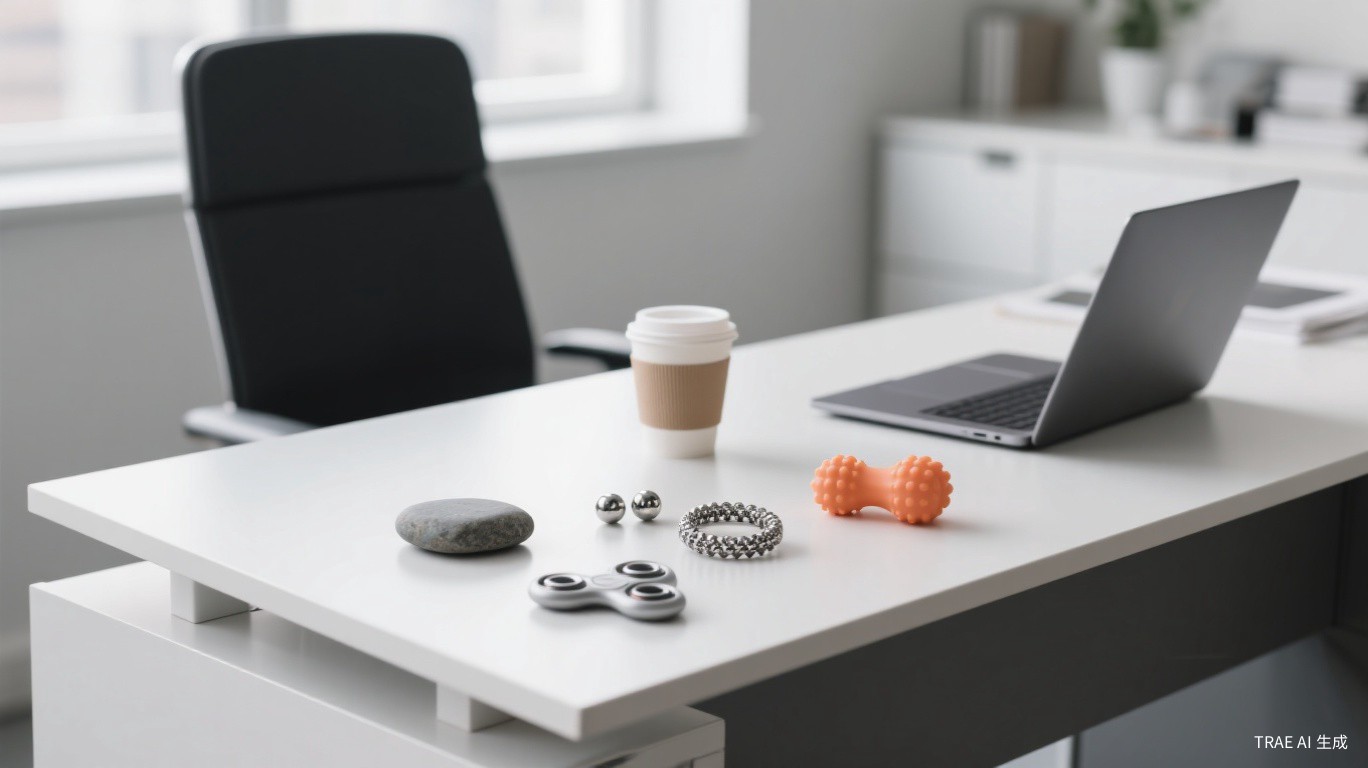
Smooth Magnetic Balls
Noise: Silent | Discretion: High | Cost: $8 to $15
Small neodymium sphere magnets (5mm to 8mm) are my go-to meeting fidget. I keep a set of six in my jacket pocket and roll them around in one hand during discussions. The magnetic attraction between the balls creates a subtle resistance that feels satisfying without any noise.
The key is to use them gently. If you let them snap together, they do make a quiet click, but if you roll them slowly, they are completely silent. The weight and coolness of the metal is grounding, and the magnetic pull gives your fingers something to work against.
I have used these in client calls, board presentations, and performance reviews. Nobody has ever noticed. They look like nothing. They sound like nothing. They feel like everything.
Textured Worry Stones
Noise: Silent | Discretion: Very High | Cost: $3 to $12
A worry stone is a smooth, polished stone with a thumb-sized indent that you rub with your thumb. They have been used for anxiety relief for centuries, and they are arguably the most discreet fidget that exists. You can keep one in your pocket and use it for an entire eight-hour day without anyone knowing.
I bought a polished jasper worry stone for $6 at a local crystal shop. It has a perfect thumb groove and a satisfying weight. I have used it during every code review for the past two years. My thumb has actually worn the groove slightly deeper, which I consider a badge of honor.
If you want something more modern, there are machined metal worry stones in titanium, stainless steel, and copper. They are more expensive ($20 to $40) but look like high-end accessories rather than fidget toys.
Silicone Squeeze Toys
Noise: Silent | Discretion: Medium | Cost: $4 to $10
Soft silicone squeeze toys like NeeDoh squishies are excellent desk fidgets. They make zero noise, they are satisfying to squeeze, and the resistance provides proprioceptive input that is genuinely calming during stressful meetings.
The one caveat is that some of the more colorful or novelty-shaped versions look unprofessional. A bright green NeeDoh Gummy Bear sitting on your desk next to your laptop might raise some eyebrows. The solution is to choose versions that look more neutral. The NeeDoh Nice Cube in a solid color is less conspicuous than the shaped versions. There are also silicone stress toys designed specifically for office environments that look like sleek desk accessories.
I keep a NeeDoh Nice Cube in my top desk drawer and pull it out during long meetings. The resistance is perfect for deep squeezing, and the material is completely silent. When someone asks about it, I just say it is a stress reliever. Nobody has ever questioned it further.
Spinning Rings
Noise: Silent | Discretion: Very High | Cost: $8 to $25
Fidget rings have a band that rotates around a stationary base. You spin the outer band with your thumb while the ring sits on your finger. From a distance, it looks like you are just fiddling with your jewelry. It is the most invisible fidget I have found.
The quality varies significantly. Cheap spinner rings ($5 to $10 on Amazon) tend to be noisy because the spinning mechanism is loose and rattles. Mid-range rings ($15 to $25) from specialty fidget retailers have smoother, quieter bearings that produce no audible sound.
I wear a stainless steel spinner ring that looks like a normal wedding band from more than three feet away. During meetings, I spin it absentmindedly with my thumb. My manager sits directly next to me and has never mentioned it.
Fabric Strips and Textured Swatches
Noise: Silent | Discretion: Very High | Cost: $2 to $5
This is the most low-tech option on the list, and it is one of the most effective. A small strip of textured fabric, velvet on one side, corduroy on the other, or faux fur, provides excellent tactile input with zero noise and zero visual distraction.
You can keep a fabric strip in your pocket and rub it between your fingers under the desk. The texture provides the sensory input your brain craves without any of the risks associated with more obvious fidgets. Nobody questions a piece of fabric. It could be a handkerchief, a cleaning cloth for your glasses, or a scrap from a sewing project.
I bought a pack of textured fabric swatches from a craft store for $4. I cut them into strips roughly 2 inches by 4 inches and keep one in each jacket pocket. They have held up for over a year with no signs of wear.
Pen-Based Fidgets
Noise: Near Silent | Discretion: High | Cost: $5 to $20
Most office workers already fidget with their pens, clicking, tapping, and spinning them. The problem is that standard pens click loudly, which is exactly the sound that got me called out in that sprint planning meeting.
The solution is a fidget pen designed for quiet manipulation. These pens have smooth, silent mechanisms for twisting, sliding, and rolling. Some have textured grips for rubbing. Others have weighted bases for spinning on a flat surface.
Important note: Even silent pen fidgets can be noisy if you drop them on a hard desk. I recommend using them over a desk pad or mouse pad to dampen any accidental drops.
Thinking Putty
Noise: Silent | Discretion: Medium | Cost: $8 to $15
Thinking putty is a silicone-based putty that can be stretched, squeezed, torn, and molded. It never dries out and provides excellent tactile feedback. It is completely silent and comes in a small tin that sits unobtrusively on a desk.
The downside for office use is that it can be visually distracting if you start stretching it dramatically during a meeting. I use it primarily at my desk during focused work rather than in meetings. During meetings, it stays in the tin and I just knead it in small motions.
Crazy Aaron's Thinking Putty is the gold standard. They offer dozens of colors, including some that change color with heat or glow in the dark. For office use, I recommend a neutral color like steel, midnight blue, or black.
Textured Desk Mats
Noise: Silent | Discretion: Very High | Cost: $10 to $25
A textured desk mat or mouse pad with different tactile zones provides passive sensory input throughout the day. You run your fingers over the textures while thinking, reading, or waiting for code to compile. It is always available, requires no pocket management, and looks like a normal desk accessory.
Some desk mats are specifically designed for sensory input with different textures in different zones: smooth leather, rough canvas, ribbed rubber, and soft felt. They double as mouse pads and desk protectors, so they serve a practical purpose beyond fidgeting.
I have one that looks like a standard leather desk pad but has a subtle textured border that I run my fingers along when I am thinking. It has been on my desk for eight months and nobody has ever asked about it.
Best Fidgets for Specific Workplace Situations
Video Calls
During video calls, your hands are often visible or partially visible on camera. You need a fidget that can be used off-screen or that looks natural on camera.
Best choices: A smooth stone held below desk level, a spinner ring on your finger, or simply rubbing a fabric strip in your lap. These are completely invisible to other participants.
Avoid: Anything that requires two hands, anything that might make noise if it hits your desk, and anything you might accidentally hold up to the camera.
Long Meetings (1+ Hours)
Extended meetings are where fidgets earn their keep. Your brain needs sustained support, not just a quick fidget break.
Best choices: Something with depth, like magnetic balls you can build shapes with, thinking putty you can knead for extended periods, or a textured worry stone with a deep thumb groove. These provide enough sensory feedback to sustain focus without becoming boring.
Avoid: Fidgets that are too simple. A smooth ball might not provide enough input for a two-hour architecture review.
Presentations and Client Calls
When you are presenting or speaking with clients, professionalism is paramount. Your fidget should be completely invisible.
Best choices: A spinner ring, a worry stone in your pocket, or a textured fabric strip. These are undetectable by anyone who is not looking directly at your hands.
Avoid: Anything on your desk, anything that requires visual attention, and anything that might make a sound if you accidentally drop it.
Deep Focus Work (Coding, Writing)
When you are heads-down at your desk, the rules are more relaxed. You can use desk-based fidgets and items that would be too visible for meetings.
Best choices: Thinking putty, desk fidget sculptures, textured desk mats, or a small magnetic desk toy. These provide ongoing sensory input without interrupting your flow.
Avoid: Fidgets that are so engaging they pull you out of your work. If you find yourself playing with the fidget instead of coding, switch to something less interesting.
How to Explain Fidgeting to Coworkers
At some point, someone will ask about your fidget. Here are some responses that work in professional settings:
- "It helps me think. I have always been a hands-busy person." (Casual, non-medical)
- "My therapist recommended it for focus." (Honest, brief, sets a boundary)
- "I concentrate better when my hands are occupied." (Simple, relatable)
- "It is a stress reliever. Better than cracking my knuckles." (Humorous, deflects further questions)
You do not owe anyone a detailed explanation. Most people will accept a brief answer and move on. If someone presses, a simple "It is just a personal preference" usually ends the conversation.
What to Avoid at Work
Based on my experience, here are the fidgets that do not belong in a professional environment:
- Fidget spinners. They are loud, they spin visibly, and they carry a strong association with children's toys. Not a good look in a boardroom.
- Clicky fidget cubes. The clicking is audible and distracting. I learned this the hard way.
- Popping toys (Pop Its). The popping sound is unmistakable and carries across a quiet room.
- Loud spinner rings. Cheap spinner rings with loose bearings rattle. Test any ring before bringing it to work.
- Anything with small parts that could fall on the floor. Retrieving scattered magnetic balls during a meeting is not a power move.
Building Your Workplace Fidget Kit
After three years of testing, here is what lives in my desk drawer and jacket pockets:
Top desk drawer: One NeeDoh Nice Cube, one Crazy Aaron's Thinking Putty in steel, one textured desk mat under my keyboard.
Left jacket pocket: A set of six magnetic balls in a small leather pouch.
Right jacket pocket: A polished jasper worry stone.
On my finger: A stainless steel spinner ring.
This kit covers every workplace situation I encounter. Meetings get the magnetic balls or worry stone. Video calls get the spinner ring. Deep work gets the thinking putty and desk mat. I rotate through them depending on the day, and I have not been called out once since I assembled this collection.
The Bottom Line
Fidgeting at work is not a sign of weakness or immaturity. It is a legitimate neurological strategy for maintaining focus and managing stress. The key is choosing fidgets that respect your coworkers' space while giving your brain the input it needs.
Start with one or two options from this guide. Test them in low-stakes situations before bringing them to important meetings. Pay attention to what works for your specific needs and your specific workplace. And if anyone gives you a hard time about it, just remember: the most productive people in your office are probably fidgeting with something under their desks right now. You just cannot hear it.
Frequently Asked Questions
Can I use fidget toys at work without annoying my coworkers?
Absolutely, if you choose the right ones. Silent fidget toys like smooth magnetic balls, textured stones, and silicone squeeze toys produce zero noise and are virtually invisible to others. Avoid anything that clicks, spins loudly, or has moving parts that create audible feedback.
What are the best fidget toys for video calls?
For video calls, use fidgets that stay below desk level or in your hand off-camera. Smooth worry stones, small silicone squeeze balls, textured finger rings, and fabric strips are all excellent choices. They provide sensory input without any visible fidgeting on camera.
Will my employer allow fidget toys at my desk?
Most employers have no policy against small desk items that do not interfere with work. Fidget toys are generally treated the same as stress balls or desk ornaments. If you have a diagnosed condition like ADHD or anxiety, fidget tools may be covered under workplace accommodation policies. When in doubt, keep your fidgets small and quiet.
Are expensive fidget toys better for the office?
Not necessarily. Many premium fidget toys are designed for aesthetics as much as function, which can be a plus in professional settings. However, plenty of affordable options perform just as well. A $3 worry stone can be just as effective as a $30 titanium spinner for managing restlessness during meetings.
How do I explain fidgeting to a coworker who asks about it?
Keep it simple and casual. Something like, "It helps me focus during long meetings" or "I find it easier to think when my hands are busy" is usually enough. Most people accept the explanation without further questions. You do not owe anyone a detailed explanation of your sensory needs unless you choose to share them.