Fidget Toys for Kids with ADHD and Autism: Parent's Guide 2026
Dr. Rachel Kim
Author
A Parent's Perspective on Fidget Toys
I am going to be honest with you: before my son was diagnosed with ADHD at age six, I thought fidget toys were a trend. I saw kids spinning fidget spinners in the grocery store and assumed it was just another craze like slap bracelets or Silly Bandz. I had no idea that those toys were doing real neurological work for some of those kids, including my own.
My son, who I will call James for this article, has always been in motion. As a toddler, he did not walk, he ricocheted. At dinner, he bounced in his chair so aggressively that we went through three sets of placemats. In kindergarten, his teacher flagged his inability to sit still during circle time. She was not mean about it. She was concerned. And when we got his ADHD diagnosis a few months later, a lot of things suddenly made sense.
What I did not understand yet was how to help him. Medication was one piece of the puzzle, but his neuropsychologist, who is now a colleague of mine (small world), told me something that changed my approach entirely: "James's brain needs input to regulate. If you do not give it controlled input, it will find uncontrolled input."
That sentence is the foundation of everything I am going to share in this guide. Fidget toys are not rewards. They are not distractions. They are sensory regulation tools, and for kids with ADHD and autism, they can be as essential as glasses are for a child who cannot see the board.
Understanding Sensory Needs in ADHD and Autism
What Is Sensory Processing?
Every brain receives information from the senses: touch, sound, sight, smell, taste, movement (vestibular), and body position (proprioception). A neurotypical brain filters and organizes this information automatically. It decides what to pay attention to and what to ignore. It adjusts arousal levels up or down as needed.
In ADHD and autism, this filtering and organizing process works differently. The brain may be over-responsive to some inputs (the tag in a shirt feels like sandpaper) or under-responsive to others (the child does not notice they are about to fall off a chair). This is not a choice. It is a neurological difference in how sensory information is processed.
Understanding where your child falls on this spectrum is the first step to choosing the right fidget.
The Sensory Diet Concept
Occupational therapists use the term "sensory diet" to describe a planned schedule of sensory activities and tools throughout the day. Just like a nutritional diet, a sensory diet provides the right inputs at the right times to keep the body and brain regulated.
A sensory diet for a child with ADHD might include: - Heavy work activities in the morning (carrying groceries, pushing a laundry basket) - A fidget tool during desk work at school - Movement breaks every 20 to 30 minutes - Calming sensory input before bedtime (weighted blanket, slow rocking)
Fidget toys are one component of a sensory diet, not the whole thing. They work best when they are part of a broader strategy that addresses all of the child's sensory needs throughout the day.
Tactile Seekers vs. Tactile Avoiders
This distinction is critical for choosing fidgets.
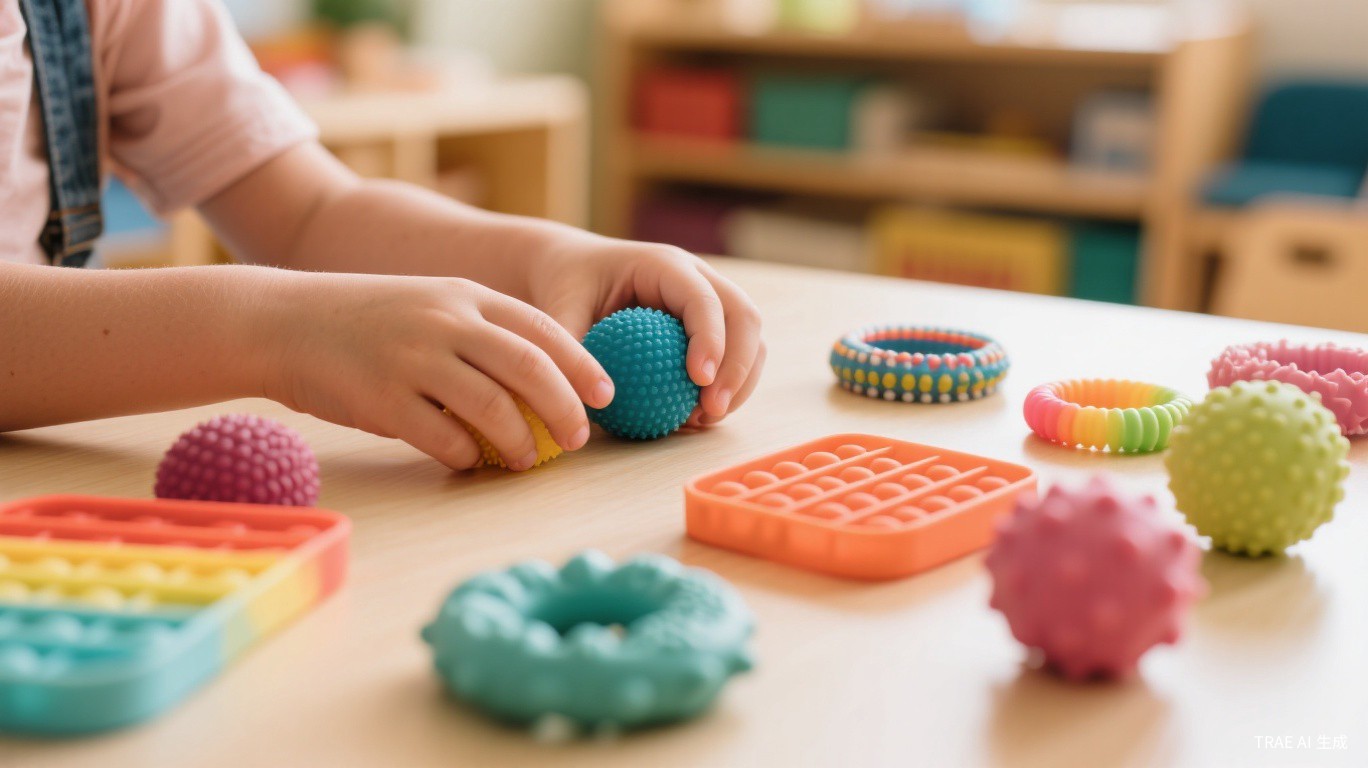
Tactile seekers want to touch everything. They run their hands along walls, fiddle with every object within reach, and prefer intense textures like rough, bumpy, or squishy surfaces. These kids tend to love fidgets like NeeDoh squishies, textured stress balls, and spiky rings.
Tactile avoiders are bothered by certain textures and sensations. They may refuse to wear certain fabrics, dislike having their hands dirty, and prefer smooth, cool surfaces. These kids do better with fidgets like smooth spinning tops, cool metal coins, or silky fabric strips.
Many children are a mix. James is a tactile seeker for his hands but an avoider for his feet. He needs rough, textured things in his hands but will only wear one specific brand of socks. Knowing your child's specific sensory profile saves you from buying a dozen fidgets that end up in a drawer.
How Fidgets Help Self-Regulation
The Arousal Model
Think of your child's brain as having an arousal dial. Too low, and they are zoned out, unfocused, and sluggish. Too high, and they are wired, impulsive, and unable to sit still. The sweet spot is somewhere in the middle, an optimal level of alertness where learning and social interaction happen naturally.
Kids with ADHD tend to run their arousal dial too low during understimulating tasks (worksheets, lectures, waiting in line) and too high during overstimulating situations (crowded assemblies, surprise schedule changes). Fidgets help by providing just enough input to bring the dial back to center.
For the child who cannot focus during reading time, a quiet fidget in their non-dominant hand provides the arousal boost their brain needs to stay engaged with the text. For the child who is overwhelmed at a birthday party, a calming fidget in their pocket provides a familiar, predictable sensory anchor.
What the Research Says
A 2015 study published in the Journal of Abnormal Child Psychology found that children with ADHD performed better on cognitive tasks when they were allowed to move and fidget. The more they moved, the better they performed. This was the opposite of what most adults expected. Another study from the University of Central Florida confirmed that fidgeting helped children with ADHD maintain alertness during boring tasks.
More recent research from 2023 expanded these findings to include children with autism spectrum disorder. The study found that access to preferred sensory tools reduced anxiety, meltdowns, and off-task behavior in autistic children during classroom activities.
The evidence is clear: fidgeting is not a symptom to eliminate. It is a coping mechanism to support.
Choosing Age-Appropriate Fidgets
Ages 2 to 4
At this age, safety is the top priority. Everything goes in the mouth. Choose large, one-piece fidgets with no small parts.
Good options: - Large textured balls (2 inches or bigger) - Silicone teething toys with interesting textures - NeeDoh Nice Cube (chunky, durable, impossible to break apart) - Sensory brushes and textured fabric squares - Large pop-it boards with oversized bubbles
Avoid: Anything with small parts, magnets, batteries, or sharp edges. Fidget spinners are not appropriate for this age group.
Ages 5 to 7
This is when many children are diagnosed with ADHD and autism, and when fidgets become especially important for school. Choose quiet, durable fidgets that can survive the rough handling of a kindergartener or first grader.
Good options: - NeeDoh Dream Drop or Gummy Bear (durable silicone squishies) - Tangle Jr (quiet, no loose parts) - Stress balls with gel or bead filling - Textured finger rings - Pop-its in small, keychain sizes
Avoid: Fidgets with removable parts, very small items that could be lost easily, and anything that makes noise in a classroom setting.
Ages 8 to 12
Older kids can handle more complex fidgets and are often more aware of which sensory inputs help them. Let them participate in choosing their fidgets.
Good options: - Infinity cubes - Magnetic balls and sculptures - Chain fidgets and roller chains - Fidget rings with spinning elements - Thinking putty or magnetic putty - Tangle Therapy (the textured version)
Avoid: Cheap metal fidgets that can pinch skin, very loud clicky toys for classroom use, and anything their specific school has banned.
Ages 13 and Up
Teenagers are often self-conscious about using fidgets, especially if they perceive them as "kid stuff." Choose fidgets that look mature, sophisticated, or even invisible.
Good options: - Fidget rings that look like normal jewelry - Smooth worry stones or polished crystals - Magnetic desk sculptures - Textured pen grips - Tangle Metallic (looks like modern art)
Avoid: Anything overly colorful or childish unless your teen specifically wants it. Respect their desire to fit in.
Sensory Input Types and Matching Fidgets
Tactile (Touch)
Tactile fidgets provide input through the skin. Textures, temperatures, and pressure all count.
Best for: Kids who seek or avoid touch, kids who pick at their skin or nails, kids who need to hold something during seated tasks.
Examples: NeeDoh squishies, textured rings, velvet fabric strips, spiky balls, thinking putty.
Visual (Sight)
Visual fidgets provide something to watch. This can be calming for kids who are visually oriented.
Best for: Kids who stare at spinning objects, kids who need a visual anchor to stay grounded, kids who zone out and need a gentle re-engagement tool.
Examples: Lava lamps (not portable, but great for rooms), glitter jars, liquid motion bubblers, spinning tops with color patterns.
Proprioceptive (Body Position and Pressure)
Proprioceptive fidgets provide input to the muscles and joints. Pushing, pulling, squeezing, and stretching all activate this system.
Best for: Kids who crash into things, squeeze too hard, or seem unaware of their own body in space. Also great for kids who need heavy work but are stuck at a desk.
Examples: Resistance bands on chair legs, theraputty, hand grip strengtheners, NeeDoh Nice Cube (the resistance is excellent), weighted lap pads.
Vestibular (Movement and Balance)
Vestibular input comes from movement, especially changes in head position. This is why kids rock in their chairs, spin in circles, and swing upside down.
Best for: Kids who cannot stop moving, kids who need to rock or sway, kids who seem dizzy or off-balance.
Note: Most fidget toys do not directly address vestibular needs. Movement breaks, wobble cushions, and rocking chairs are better tools for this system. However, some fidgets like spinning tops and gyroscopic rings provide mild vestibular-adjacent input through visual tracking.
Safety Considerations
Choking Hazards
This is the number one concern, especially for younger children and kids who mouth objects (which is common in autism). Any fidget smaller than a toilet paper tube core is a potential choking hazard for children under 5. Even older kids who mouth objects should be supervised with small fidgets.
Rule of thumb: If your child puts non-food items in their mouth, stick to large, one-piece fidgets. No magnets, no small balls, no detachable parts.
Magnets
Neodymium magnets are incredibly dangerous if swallowed. If a child swallows two or more magnets, they can attract through the walls of the intestines and cause perforations, blockages, and life-threatening injuries. Many countries have banned the sale of small magnet sets for this reason.
Keep magnet fidgets away from any child who mouths objects, regardless of age.
Durability
Kids with ADHD and autism often use fidgets more intensely than neurotypical kids. A fidget that breaks on the first day is not just a waste of money, it is a safety hazard if it breaks into small pieces.
Look for fidgets made from solid silicone, medical-grade rubber, or single-piece construction. Avoid fidgets with thin plastic, glued joints, or exposed batteries.
Chemical Safety
Cheap fidget toys, especially those from unregulated overseas sellers, may contain lead, phthalates, or other harmful chemicals. Buy from reputable brands and check for safety certifications like ASTM F963 (the US toy safety standard) or CE marking.
Building a Sensory Toolkit
A sensory toolkit is a collection of fidgets and sensory tools organized by need and setting. Here is how I built James's toolkit:
The School Kit
This lives in his backpack and comes out during desk work.
- 1 quiet fidget for his dominant hand (currently a Tangle Jr)
- 1 tactile fidget for his non-dominant hand (a small NeeDoh)
- 1 emergency calming tool (a smooth worry stone he keeps in his pocket)
The Home Kit
This is a larger collection in a designated box in his room.
- Heavy work tools (resistance bands, a weighted lap pad)
- A variety of squishy, stretchy, and textured fidgets
- A glitter jar he made himself for calming down after meltdowns
- A wobble cushion for his desk chair
The Travel Kit
This is a small pouch that comes in the car and on trips.
- 2 to 3 portable fidgets that will not get lost easily
- Noise-canceling earbuds (for auditory sensitivity)
- A familiar comfort object
The Calm-Down Corner
This is a specific space in our house where James goes when he is overwhelmed. It is not a punishment. It is a regulation station.
- Weighted blanket
- Dim lighting
- A basket of preferred fidgets
- A feelings chart
- A timer so he knows when his break is over
Communicating with Teachers
This is where many parents struggle. You know your child needs a fidget, but you are worried the teacher will see it as a toy or a distraction. Here is what has worked for me:
Be proactive, not reactive. Do not wait until the teacher confiscates a fidget to have the conversation. Reach out at the beginning of the school year.
Frame it therapeutically. Say, "James's occupational therapist has recommended fidget tools as part of his sensory diet. Here is what she suggests for the classroom." When a recommendation comes from a professional, teachers are much more receptive.
Offer a trial period. Suggest trying the fidget for two weeks and then checking in. This gives the teacher an easy out if it is not working and shows that you are collaborative, not demanding.
Put it in writing. If your child has a 504 plan or IEP, include specific language about fidget use. This protects your child's right to use sensory tools and gives the teacher clear guidelines.
Provide a fidget contract. Some therapists recommend a simple agreement between the child and teacher about fidget rules: when it can be used, how it should be used (quietly, in their lap), and what happens if it becomes a distraction. James's teacher loved this idea because it gave her clear boundaries.
When to Consult an Occupational Therapist
If your child is constantly fidgeting and it is interfering with their daily life, if they are avoiding certain textures or environments, if they are having frequent meltdowns related to sensory overload, or if you are unsure which type of sensory input they need, it is time to see an occupational therapist who specializes in sensory processing.
An OT can conduct a formal sensory profile assessment that identifies your child's specific sensory preferences and aversions across all sensory systems. This assessment takes the guesswork out of choosing fidgets and sensory strategies. Many parents, myself included, spend hundreds of dollars on fidgets before seeing an OT, only to find out that half of them were wrong for their child's sensory profile.
The sensory profile assessment was the best investment we made in James's sensory toolkit. It told us exactly what he needed, when he needed it, and why. I went from buying random fidgets on Amazon to making targeted, effective choices. His teacher noticed the difference within a week.
Final Thoughts
Raising a child with ADHD or autism means becoming a student of their nervous system. You learn to read the signs: the bouncing that means they are under-stimulated, the covering of ears that means they are overwhelmed, the skin-picking that means they need tactile input. Fidget toys are one of the most accessible, affordable, and effective tools in your toolkit.
Do not be afraid to experiment. Buy a few different types, let your child try them, and pay attention to what works. The right fidget will become almost invisible, your child will use it without thinking about it, and you will see improvements in focus, behavior, and emotional regulation.
And if you are anything like me, you will end up with a drawer full of fidgets that did not quite work. That is okay. Every fidget that does not work gets you closer to the one that does. Trust the process, trust your child, and trust your instincts. You know your kid better than any guide on the internet, including this one.
Frequently Asked Questions
Do fidget toys actually help kids with ADHD?
Yes, research supports that fidget toys can help children with ADHD by providing the sensory stimulation their brains need to maintain optimal arousal levels. Controlled fidgeting can improve attention, working memory, and task completion. The key is choosing the right type of fidget for the child's specific sensory needs and the setting they are in.
What is the difference between sensory-seeking and sensory-avoiding behavior?
Sensory-seeking children actively crave more input, they want to touch everything, move constantly, and seek out intense sensations. Sensory-avoiding children are overwhelmed by too much input and prefer calm, predictable environments. Many children show a mix of both patterns depending on the sensory system involved (tactile, auditory, vestibular, etc.).
At what age can children start using fidget toys?
Children can begin using fidget toys as early as 18 months with age-appropriate, large items that pose no choking hazard. By age 3, most children can safely use a wider range of fidgets with supervision. Always check manufacturer age recommendations and assess your individual child's mouthing behavior before introducing small fidget toys.
Should I talk to my child's teacher about fidget toys?
Yes, communication with your child's teacher is essential. Explain the therapeutic purpose of the fidget, offer to let the teacher try it, and discuss guidelines for use. Many teachers are receptive once they understand that fidgets are regulation tools, not toys. Including fidget use in a 504 plan or IEP can provide formal support.
How do I know if a fidget toy is helping or distracting my child?
Observe your child's behavior over two to three weeks. A helpful fidget will be used almost unconsciously while your child completes tasks, it fades into the background. A distracting fidget becomes the focus of attention, your child watches it, plays with it actively, or loses track of what they were doing. If the fidget consistently pulls attention away, try a different type.