Fidget Cube vs Fidget Spinner: Which Calms Anxiety Better? 2026
Dr. Sarah Mitchell
Author
I keep both a fidget cube and a fidget spinner in my desk drawer at my practice. Not because I use them during sessions, but because when a client asks me which one they should buy, I hand them both and let them decide for themselves. After eight years of recommending fidget tools, I have learned that the answer to "which is better" is almost always "it depends on you."
That said, there are real, meaningful differences between these two products. Differences in how they work, what sensory input they provide, and how effective they are for different types of anxiety and focus challenges. I have seen clients thrive with one and feel nothing with the other. I have watched people walk into my office convinced they need a spinner and leave with a cube, or the reverse.
This guide is my attempt to lay out those differences clearly so you can make an informed choice without having to buy both. Though honestly, at ten to fifteen dollars each, buying both is not the worst idea.
A Brief History of Both Products
Understanding where these products came from helps explain why they work the way they do.
The Fidget Spinner
The fidget spinner exploded into public consciousness in 2017, though its origins go back further. Catherine Hettinger is often credited with inventing a precursor to the modern spinner in the early 1990s, though the design evolved significantly before reaching the version that took over the world.
The 2017 craze was extraordinary. Spinners were everywhere. Schools were banning them. Parents were fighting over the last ones in stock at toy stores. News outlets were running segments about whether they helped or hindered concentration. The hype was intense and, predictably, it faded just as quickly.
What remained after the craze was a legitimate fidget tool that many people, including a significant number of my clients, found genuinely helpful. The spinner did not stop being useful just because it stopped being trendy.
The Fidget Cube
The fidget cube was born on Kickstarter in 2016, created by the Antsy Labs team. It was designed from the ground up as a fidget tool, which gives it a different DNA than the spinner. The Kickstarter campaign raised over six million dollars, which tells you something about the demand for tactile fidget tools.
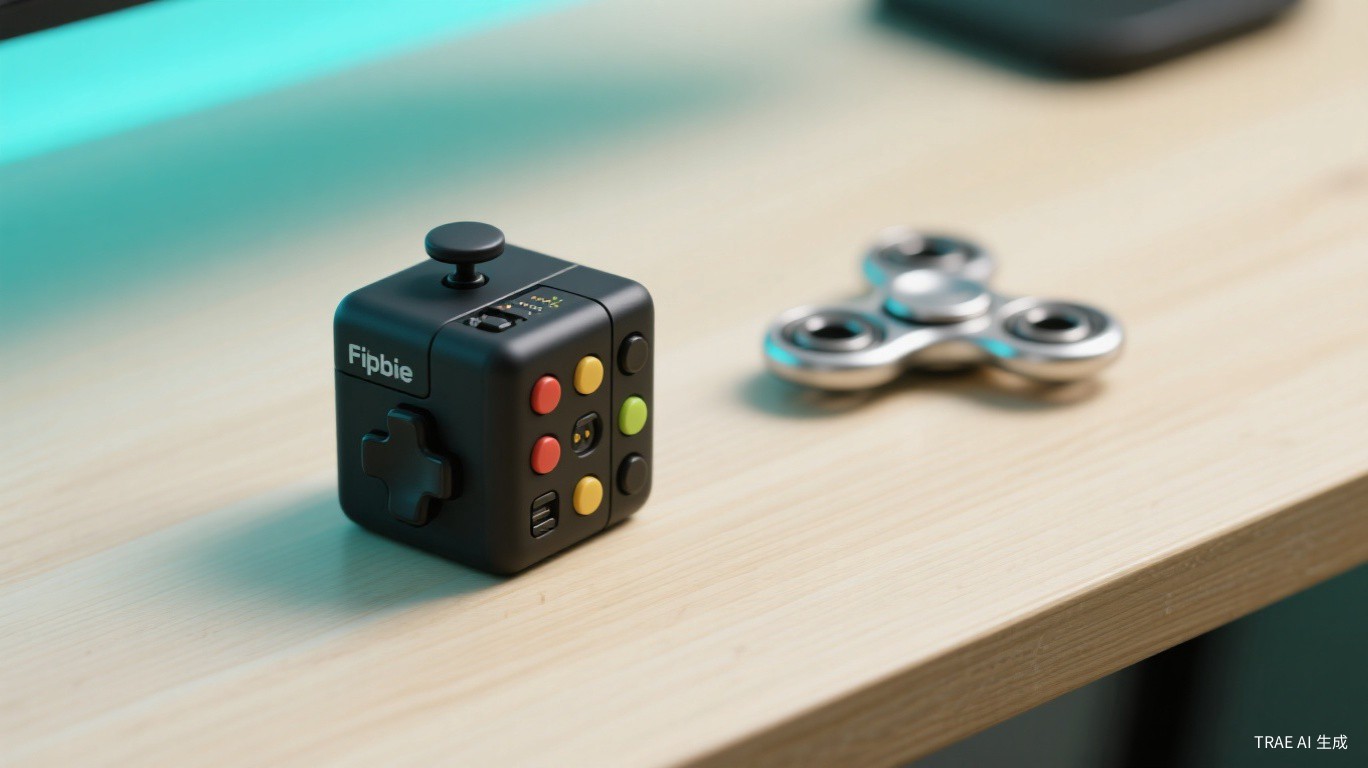
The cube was designed with input from people who actually fidget. Each of its six faces offers a different tactile experience: a toggle switch, a small joystick, buttons you can click, gears you can roll, a spinning disk, and a smooth surface you can rub. It was engineered to give your hands options.
Where the spinner was a happy accident that turned out to be useful, the cube was a deliberate attempt to create the perfect fidget tool. Whether it succeeded depends on what you need.
How Each One Works
Let me get into the mechanics of each product because the physical experience of using them is fundamentally different.
Fidget Spinner Mechanics
A fidget spinner has a central bearing and two or three weighted arms that extend outward. You hold the center between your thumb and finger and flick one of the arms. The spinner rotates on the bearing, typically for thirty seconds to several minutes depending on the quality of the bearing and the weight of the arms.
The experience is passive once you get it going. You flick, and then you watch or feel it spin. Some people stare at the spinning motion, which can be mesmerizing. Others close their eyes and focus on the vibration and weight in their hand. A few people I work with use spinners under their desk during meetings, feeling the rotation through their fingertips.
The sensory input is primarily proprioceptive (the feeling of weight and motion in your hand) and visual (watching the arms blur into a circle). There is minimal tactile variation. It is the same motion every time.
Fidget Cube Mechanics
The fidget cube is the opposite approach. Instead of one motion repeated, it offers six different tactile experiences packed into a small cube that fits in your palm.
Each face provides different sensory input:
- Toggle switch: A small switch that clicks back and forth. Satisfying for people who like switches and buttons.
- Clickable buttons: Three buttons that can be clicked. One is silent, two produce a clicking sound. Good for people who compulsively click pens.
- Joystick: A tiny thumbstick similar to a game controller. Smooth and satisfying for rolling motions.
- Gears: Three small gears you can roll with your thumb. Continuous motion without a distinct click.
- Spinning disk: A concave surface with a spinning element. Similar to a spinner but smaller and more contained.
- Smooth surface: A flat, slightly textured surface for rubbing. The quietest option and good for people who like to stroke or rub objects.
The sensory input is tactile and varied. You are constantly switching between different types of stimulation, which is a fundamentally different experience from the spinner's single repetitive motion.
Anxiety Relief: Which Works Better?
This is the question I get asked most often, and it is the hardest to answer honestly because anxiety is not one thing. Different types of anxiety respond to different types of sensory input.
Generalized Anxiety
For people with generalized anxiety disorder who experience persistent, low-level worry, I tend to recommend the fidget cube. The reason is variety. Generalized anxiety often manifests as a restless mind that jumps from worry to worry. The cube's multiple faces give your hands a similar variety of stimulation, which seems to match the restless energy better.
I have had clients describe it as giving their hands something to do that is interesting enough to hold their attention but not so interesting that it becomes its own distraction. The ability to switch from clicking buttons to rolling gears to rubbing the smooth surface gives the mind a low-level stream of sensory input that can interrupt the worry cycle.
Panic and Acute Anxiety
For moments of acute anxiety or the onset of panic, I lean toward the fidget spinner. The spinning motion is rhythmic and predictable. You can focus on the rotation, time your breathing to the spin, and let the repetitive motion ground you in the present moment.
Several of my clients have developed breathing exercises paired with their spinners. They breathe in for one rotation, out for the next. The spinner gives them a visual anchor for the breathing technique, which makes it more effective than breathing exercises alone.
Social Anxiety
For social anxiety, the fidget cube wins on one condition: you use the silent features. The smooth rubbing surface, the joystick, and the silent button are all completely invisible to the people around you. You can keep the cube in your pocket and use it with one hand without anyone knowing.
Fidget spinners are also discreet in a pocket, but the spinning motion is more restricted in that context. You can spin it in a pocket, but it does not feel the same as spinning it freely in your hand.
Focus Improvement: Which Helps More?
This is where I see the biggest split between the two products, and it correlates strongly with the type of work being done.
For Repetitive or Boring Tasks
The fidget spinner wins here. When you are doing something monotonous like data entry, reading long documents, or sitting through a lecture on a topic you already understand, the spinner provides a steady background stimulation that helps maintain alertness without pulling your attention away from the task.
The key is that the spinner does not require any decision-making. You flick it and it spins. Your hands can manage it on autopilot while your brain focuses on the work. The fidget cube, with its multiple options, introduces tiny micro-decisions about which face to use, which can actually pull focus from the primary task.
For Creative or Problem-Solving Work
The fidget cube is better for tasks that require creative thinking. When you are brainstorming, writing, or working through a complex problem, the variety of tactile input from the cube seems to stimulate different types of thinking. I have clients who swear by the gear-rolling face for writing and the toggle switch for brainstorming.
The theory, which is supported by some research on sensory stimulation and cognitive function, is that varied tactile input activates more areas of the brain, which can support divergent thinking. I am cautious about overselling this claim, but the anecdotal evidence from my practice is consistent enough that I feel comfortable recommending the cube for creative work.
For Studying
This depends entirely on what you are studying and how you study. For reading-heavy studying, I recommend the spinner because it provides background stimulation without visual distraction. You can spin it with one hand while holding a textbook with the other.
For active studying like flashcards, problem sets, or practice tests, the cube works better because the varied input matches the more active engagement of the studying itself.
Noise Levels
This matters more than people expect. If you are using your fidget tool in a quiet classroom, an open-plan office, or next to a sleeping partner, noise is a real concern.
Fidget spinners are nearly silent. The bearing produces a faint whirring sound that is only audible if someone is very close to you. In any normal environment, a spinner is completely inaudible to the people around you.
Fidget cubes vary by feature. The clicky buttons are genuinely loud. In a quiet classroom, your neighbor will hear every click. The toggle switch produces a softer but still audible click. The joystick, gears, spinning disk, and smooth surface are all very quiet to silent.
If noise is a primary concern, the spinner is the safer bet. If you get a cube, stick to the quiet features when you are in shared spaces.
Portability
Both are highly portable, but they have different profiles.
A fidget spinner is typically about two to three inches across and roughly half an inch thick. It is flat and round, which means it slides easily into a pocket but can feel like a bulky disc in slim-fit pants. It is light enough that you forget it is there.
A fidget cube is roughly one and a half inches on each side. It is small enough to disappear into a closed fist. It fits in a coin pocket, a jacket pocket, or a bag without any issues. Some people attach a small lanyard to the cube's corner and clip it to their bag.
Neither is going to be a burden to carry. The cube is slightly more pocket-friendly because of its boxy shape, but the difference is marginal.
Durability
Fidget spinners have one main point of failure: the bearing. Cheap spinners use low-quality bearings that develop wobble or grinding after a few weeks. Higher-end spinners use ceramic or hybrid bearings that can last for years. The body of a spinner is generally tough unless it is made of brittle plastic.
Fidget cubes are more mechanically complex, which means more potential failure points. The buttons can lose their click. The switch can develop play. The joystick can get loose. However, quality cubes from reputable manufacturers hold up well to daily use. I have had my personal fidget cube for four years and all six faces still work properly.
In terms of pure durability, a high-quality spinner with a ceramic bearing will probably outlast a fidget cube. But a well-made cube should give you at least two to three years of daily use.
Price Comparison
Both products are available at similar price points, making cost a non-factor in the decision.
Fidget spinners: Three to twenty-five dollars for most models. Budget spinners under five dollars are usually poor quality. The sweet spot is ten to fifteen dollars for a metal spinner with a good bearing. Premium spinners with titanium bodies and ceramic bearings can run thirty to fifty dollars.
Fidget cubes: Five to twenty dollars for most models. The original Antsy Labs cube runs about fifteen to twenty dollars. Knockoff versions are available for five to eight dollars but the quality of the tactile feedback is noticeably worse. I recommend spending the extra money on the original or a well-reviewed alternative.
Which Should You Choose?
After years of recommending both to different clients, here is my honest breakdown of who benefits most from each.
Choose the Fidget Spinner If:
- You need something for moments of acute anxiety or panic
- You do repetitive or boring tasks and need background stimulation
- You want the quietest possible option
- You prefer a simple, one-motion fidget that you can do on autopilot
- You are drawn to spinning or rotational motion
- You want something that doubles as a visual focus tool
Choose the Fidget Cube If:
- You experience generalized anxiety with restless energy
- You need variety in your sensory input
- You do creative or problem-solving work
- You are a pen-clicker, nail-biter, or skin-picker who needs multiple tactile alternatives
- You want one tool that covers a wide range of fidget behaviors
- You like having options and tend to get bored with a single motion
Choose Both If:
- You are not sure what type of fidgeting you prefer
- You experience different types of anxiety in different situations
- You want a spinner for quiet environments and a cube for when noise does not matter
- You are buying for a household where different family members have different preferences
My Professional Recommendation
If I could only recommend one fidget tool to a new client without knowing anything about them, I would choose the fidget cube. Here is my reasoning.
The cube offers more versatility. With six different tactile experiences, the odds that at least one of them resonates with you are high. I have rarely met someone who tried all six faces of a fidget cube and did not find at least one that felt right. The spinner is a single experience. If spinning does not do it for you, the whole product is useless to you.
That said, I have clients who tried the cube first and found it underwhelming, only to discover that a spinner was exactly what they needed. The rhythmic, meditative quality of spinning is uniquely calming for certain people in a way that the cube cannot replicate.
The honest answer is that both products are good at what they do. They are not competing for the same niche. They address different sensory needs and serve different anxiety patterns. The best fidget tool is the one you actually reach for when you need it. Buy whichever one sounds more appealing based on what you have read here, give it a genuine two-week trial, and pay attention to whether your hands naturally reach for it when you are stressed. That is your answer.
Frequently Asked Questions
Is a fidget cube or fidget spinner better for anxiety?
It depends on the type of anxiety you experience. Fidget cubes offer more variety with multiple tactile options like buttons, switches, and dials which work well for people who need diverse sensory input. Fidget spinners provide a single, rhythmic spinning motion that some people find more meditative and calming.
Which is quieter, a fidget cube or fidget spinner?
Fidget spinners are generally quieter because they produce almost no sound when spinning. Fidget cubes can be noisier depending on which feature you use. The clicking buttons and switches on some cubes produce audible sounds, while the spinning dial and rubbing surface are nearly silent.
Can fidget toys actually help with focus at work?
Yes, research suggests that fidget toys can help people with ADHD and anxiety maintain focus during monotonous or stressful tasks. The key is choosing a fidget that provides enough stimulation to occupy restless energy without being so engaging that it becomes a distraction itself.
Are fidget spinners still popular in 2026?
While the initial craze has died down, fidget spinners remain a popular fidget tool among people who genuinely use them for anxiety and focus. The market has matured with higher quality options available. They are less of a cultural phenomenon now and more of a practical tool.
Which is more portable, a fidget cube or fidget spinner?
Both are highly portable but in different ways. A fidget spinner is flat and fits easily in a pocket but is round and can feel bulky. A fidget cube is more compact and box-shaped, fitting neatly in a pocket or bag. Neither takes up significant space, so portability is roughly equal.