Chewable Fidget Toys for Adults: Oral Sensory Tools That Actually Work 2026
Dr. Emily Foster
Author
I bit my nails for twenty-six years. Not just a little nibble here and there. I am talking about the kind of nail biting where your fingertips are raw and bleeding and you hide your hands in your pockets because you are embarrassed by how they look. I tried bitter nail polish. I tried rubber bands on my wrist. I tried willpower, which lasted about as long as you would expect.
The thing that finally broke the habit was a piece of silicone shaped like a pendant that I could chew on instead. I know how that sounds. A grown woman chewing on a necklace in public. But here is what I have learned after two years of using chewable fidget tools: nobody notices, nobody cares, and the relief is immediate.
If you are someone who bites your nails, chews your lips, gnaws on pen caps, stress eats when you are not hungry, or just has a persistent need to have something in your mouth, this guide is for you. Oral sensory tools are not just for kids, and they are not weird. They are a legitimate, therapist-recommended strategy for managing a specific type of sensory need.
Why Adults Need Oral Sensory Input
Let me explain the science behind this, because understanding why you chew is the first step toward finding a healthier way to satisfy that need.
Your mouth is one of the most sensory-rich areas of your body. The lips, tongue, gums, and jaw are packed with nerve endings that provide intense feedback to your brain. From the moment you are born, oral stimulation is your primary way of self-soothing. Babies suck their thumbs. Toddlers put everything in their mouths. This is not a behavior you grow out of. It is hardwired.
For many adults, the need for oral sensory input does not disappear. It just gets buried under social norms that tell you it is not acceptable to chew on things. So the need expresses itself in less obvious ways. Nail biting. Lip chewing. Pen cap destruction. Gum addiction. Stress eating. Smoking.
The insight that changed everything for me was realizing that these behaviors are not character flaws. They are your nervous system seeking the oral input it needs to regulate itself. When you give your body a safe, appropriate way to get that input, the destructive behaviors often decrease on their own.
The Stress Eating Connection
This deserves its own section because it is the one that surprises people the most. A lot of what we call stress eating is not actually about hunger. It is about oral stimulation. You are not reaching for chips because your body needs calories. You are reaching for chips because your mouth wants something to do.
I started noticing this pattern in myself long before I discovered chewable fidget tools. I would eat entire bags of pretzels during study sessions, not because I was hungry but because I needed to be chewing on something. The act of chewing was the point, not the food.
When I started using a chewable pendant, my between-meal snacking dropped by probably forty percent. Not because I was trying to diet, but because the oral need was being met by something that was not food. I was not white-knuckling it through cravings. The cravings just were not there because the underlying sensory need was already satisfied.
Types of Chewable Fidget Toys for Adults
The market for adult chewable fidget tools has grown significantly in recent years. Here are the main categories and what I have learned about each through personal use and clinical experience.
Chew Necklaces
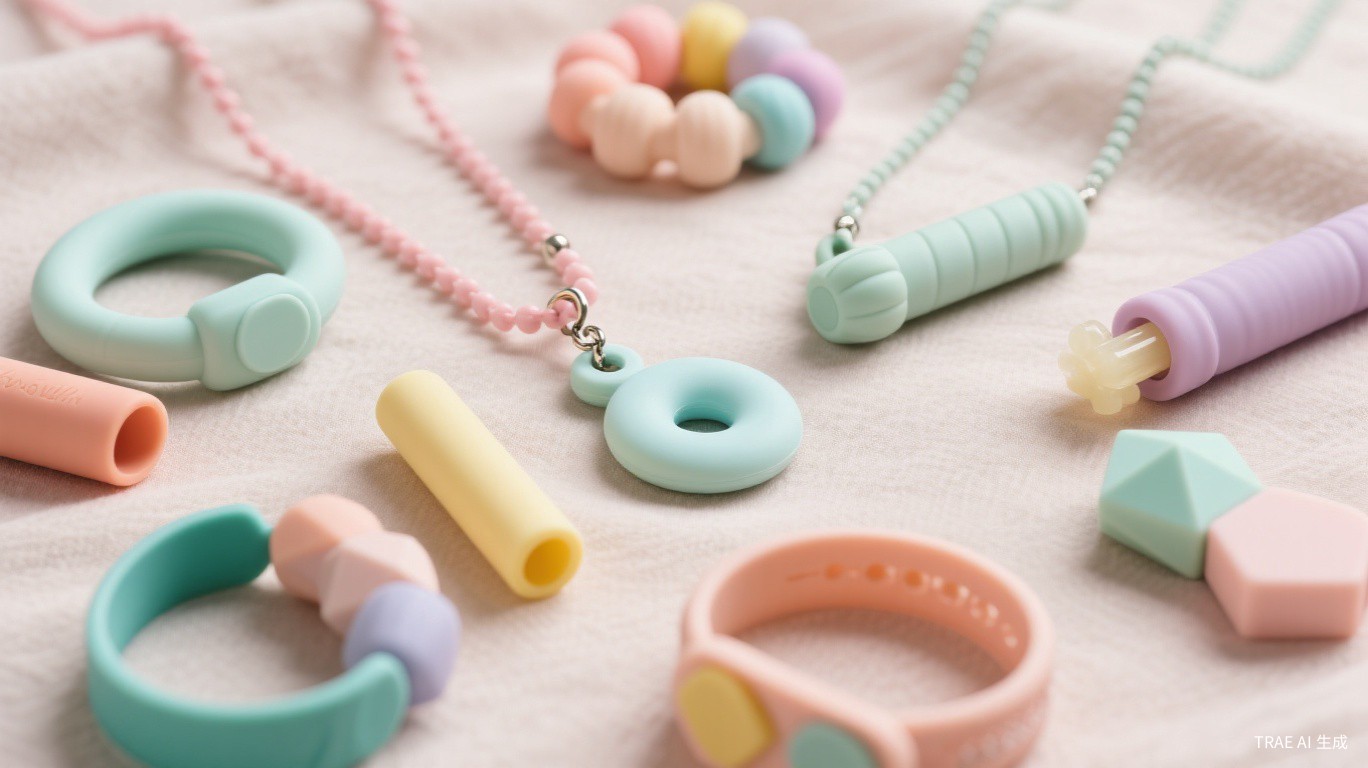
The most popular option and the one I started with. A chew necklace is a pendant made of food-grade silicone on a cord or chain that you wear around your neck. When you need to chew, you bring the pendant to your mouth. When you do not need it, it sits against your chest like any other necklace.
The pendants come in a huge range of shapes. Some look like gemstones or geometric shapes. Others are designed to look like dog tags, crystals, or abstract art pieces. The goal is to make them look like intentional jewelry so you can wear them without anyone knowing they are chew tools.
I own about eight different chew necklaces. My everyday one is a simple teardrop shape in dark gray that looks like a modern pendant. I have gotten compliments on it. Nobody has ever guessed what it actually is.
Best for: Daily use, work environments, social situations, people who want something always accessible.
Chew Bracelets
Similar concept but worn on the wrist. A silicone bracelet with a chewable section integrated into the design. Some look like standard silicone wristbands. Others have a larger bead or pendant built into the band that you can chew on.
I find chew bracelets less comfortable than necklaces because the chewable section sits on your wrist, which means you have to bring your hand to your mouth rather than just tilting your head down. But some people prefer them because they are even less noticeable than a necklace.
Best for: People who prefer wrist-worn accessories, very discreet use, athletes and active people.
Chew Pencil Toppers
Silicone caps that fit over the end of a pen or pencil. You chew on the cap instead of destroying the pen itself. If you are someone who chews through pen caps like they are made of candy, this is a direct replacement.
The downside is that they are only useful when you are holding a pen or pencil, which limits their application. But for students and office workers who spend a lot of time writing, they are a targeted solution.
Best for: Students, writers, people who chew pen caps, focused work sessions.
Chew Tubes and Stix
Cylindrical or stick-shaped chew tools that you hold in your hand and chew on directly. They are not designed to be worn as jewelry. Think of them as a more structured version of chewing on a straw.
These tend to be the most satisfying for heavy chewers because they offer more material to bite down on. The resistance is firmer than necklaces, which provides stronger proprioceptive feedback to the jaw. Occupational therapists often use these in clinical settings.
Best for: Heavy chewers, sensory-seeking individuals, home and clinical use, people who do not need discretion.
Chewable Fidget Combos
Some products combine chewable elements with other fidget features. A chewable pendant with a textured back you can rub. A bracelet with both chewable sections and clicker buttons. These multi-sensory tools are great for people who have more than one type of sensory need.
Best for: People with multiple sensory needs, those who want variety in a single tool.
Materials and Safety
This is the most important section of this guide. When you are putting something in your mouth regularly, safety is not optional.
Food-Grade Silicone
Every reputable chewable fidget tool is made from food-grade silicone. This is the same type of silicone used in baby bottle nipples, baking molds, and medical devices. It is non-toxic, free of BPA, PVC, phthalates, lead, and latex. It can be sterilized by boiling. It does not harbor bacteria the way porous materials do.
If a chew tool does not explicitly state that it is made from food-grade silicone, do not buy it. This is non-negotiable. Cheap chew toys from unknown manufacturers may use industrial silicone or other materials that are not safe for oral contact.
Firmness Levels
Chewable fidget tools come in different firmness levels, usually described as soft, medium, and firm. This matters more than you think.
Soft: Best for light chewers and people who mostly suck on the tool rather than bite it. Feels gentle on the teeth and gums. Not recommended for heavy chewers because it tears more easily.
Medium: The most versatile option. Provides enough resistance for moderate chewing without being too hard on the jaw. This is what I recommend for most adults starting out.
Firm: Designed for heavy chewers who need strong resistance. The firmer silicone provides more proprioceptive feedback and lasts longer under aggressive chewing. However, it can be hard on teeth if you are a clencher rather than a chewer. If you have dental issues, stick with medium.
What to Avoid
- Products that do not list their material. If the seller cannot tell you what it is made of, assume it is not safe.
- Extremely cheap options from unknown brands. A chew necklace for two dollars is almost certainly not made from food-grade silicone.
- Products with small parts that could break off. Any chew tool should be a single piece of silicone or have connections strong enough that nothing can detach and become a choking hazard.
- Hard plastic or rubber chew toys. These are not designed for adult jaws and can damage teeth.
Discreet Options for Work
This is the number one concern I hear from adults who are interested in chewable fidget tools. "I want to use one, but I cannot be chewing on a necklace in a meeting."
I get it. I had the same concern. Here is what I have learned.
What Actually Happens When You Use One in Public
Nothing. That is what happens. I have been wearing a chew necklace to work for two years. I have used it in meetings, at my desk, in the break room, and at after-work drinks. Nobody has ever asked me about it or given me a strange look.
Here is why. People are not paying as much attention to you as you think. The pendant sits against my chest when I am not using it. When I bring it to my mouth, it looks like I am touching my necklace, which is a completely normal thing that people do all the time. The chewing motion is subtle, especially if you are using a pendant that fits partially behind your lips.
The Most Discreet Options
- Small, dark-colored pendants. A simple geometric shape in black, gray, or navy blue looks like modern jewelry. Avoid bright colors, novelty shapes, or anything that looks like it belongs on a child.
- Bracelet-style chew tools. Even more invisible than a necklace. You can bring your wrist to your mouth naturally while thinking or reading.
- Pencil toppers. If you are already holding a pen, chewing on the end is completely normal behavior. Nobody will know the cap is designed for it.
- Inner-shirt option. Tuck the necklace inside your shirt so only the cord is visible. Pull the pendant out when you need it and tuck it back in after.
When Discretion Does Not Matter
At home. In your car. In therapy. With close friends and family. In these settings, use whatever chew tool you want without worrying about how it looks. The goal is to meet your sensory needs, not to perform normalcy for an audience.
Cleaning and Replacement
Chewable fidget tools need regular cleaning because they go in your mouth. This is not complicated, but it is important.
Daily Cleaning
Wash your chew tool with warm water and mild dish soap at the end of each day. Rinse thoroughly and let it air dry. If you have been sick, wash it more frequently.
Weekly Deep Clean
Once a week, boil your silicone chew tool for two to three minutes to sterilize it. Let it cool completely before using it. This kills any bacteria that soap and water might have missed.
When to Replace
Replace your chew tool every two to three months with regular daily use. Replace it immediately if you notice:
- Tears or cracks in the silicone
- Pieces that have been chewed off or are hanging loose
- Discoloration that does not wash off
- A persistent odor even after boiling
- Changes in texture or firmness
Heavy chewers may need to replace their tools monthly. This is normal and expected. Budget for it the way you would budget for replacing a toothbrush.
Cord and Clasp Maintenance
If you use a chew necklace, check the cord and clasp regularly. Cords can fray over time, especially if you tend to fidget with them. Most manufacturers sell replacement cords, or you can use any breakaway lanyard cord. The breakaway feature is important for safety. If the cord gets caught on something, it should snap free rather than pulling on your neck.
Who Benefits Most from Oral Sensory Tools
Based on my clinical experience and the research literature, here are the groups that tend to benefit most from chewable fidget tools.
Adults with ADHD
ADHD often involves sensory-seeking behavior, and oral stimulation is one of the most common forms. Adults with ADHD frequently chew on pens, bite their nails, or chew gum constantly. A chewable fidget tool provides the same sensory input in a more hygienic and intentional way.
Many of my clients with ADHD report that having something to chew on during work helps them maintain focus. The oral stimulation seems to occupy the part of the brain that would otherwise seek distraction through less productive means.
Adults on the Autism Spectrum
Sensory processing differences are a core feature of autism, and many autistic adults have a strong need for oral sensory input. Chewable tools can serve as a self-regulation strategy during overwhelming situations, transitions between activities, or periods of sensory overload.
The proprioceptive input from chewing has a grounding effect that can help prevent meltdowns and reduce anxiety. Several of my autistic clients describe their chew necklace as one of their most important daily tools.
People with Anxiety Disorders
Anxiety often manifests in the jaw and mouth. Jaw clenching, teeth grinding, lip chewing, and nail biting are all common anxiety behaviors. A chewable tool gives the jaw something to do that is not destructive.
The act of chewing also activates the parasympathetic nervous system, similar to how deep breathing works. Rhythmic chewing can lower cortisol levels and reduce the physical symptoms of anxiety.
Nail Biters and Skin Pickers
This is personal for me. Nail biting and skin picking are body-focused repetitive behaviors that are driven by the same sensory-seeking impulse. A chewable tool redirects that impulse toward a safe target.
I will not pretend it is a magic cure. I still occasionally catch myself reaching for my nails when I am deep in thought. But the frequency has dropped by probably eighty percent since I started using chewable fidget tools, and my nails are actually long enough to clip now for the first time in my adult life.
People Recovering from Smoking
Oral fixation is a real challenge during smoking cessation. The cigarette provides not just nicotine but also oral stimulation, hand-to-mouth motion, and a rhythmic activity. Chewable fidget tools can address the oral and hand-to-mouth components while nicotine replacement handles the chemical dependency.
I have worked with several clients in smoking cessation programs who found chewable tools helpful, particularly during the first few weeks when the oral craving is strongest.
How to Get Started
If you have read this far and you are thinking about trying a chewable fidget tool, here is my advice for getting started.
- Start with a medium-firmness chew necklace in a color you like. This is the most versatile option and the easiest to incorporate into daily life.
- Wear it for a full week before deciding if it helps. The first day might feel strange. Give yourself time to adjust to having something new to chew on.
- Pay attention to when you reach for it. Notice which situations trigger your chewing urge. This information is valuable for understanding your sensory patterns.
- Do not judge yourself. If you find yourself chewing on it constantly for the first few days, that is normal. Your body is catching up on sensory input it has been seeking for years.
- Get a second one as a backup. Chew tools wear out, and you do not want to be without one when your first needs replacing.
The most important thing I can tell you is this: there is nothing wrong with needing oral sensory input. It is a normal, biological need that some people have more strongly than others. Meeting that need with a safe, purpose-built tool is not childish or embarrassing. It is smart. It is self-aware. And for people like me, it is genuinely life-changing.
Frequently Asked Questions
Are chewable fidget toys safe for adults?
Yes, chewable fidget toys designed for adults are made from food-grade silicone that is BPA-free, latex-free, and non-toxic. They are specifically engineered to withstand chewing without breaking apart. Always buy from reputable brands and inspect your chew tool regularly for signs of wear.
Can chewable fidget toys help with stress eating?
Many people find that chewing on a sensory tool satisfies the oral fixation that drives stress eating. While it is not a complete solution for emotional eating, it can reduce the frequency of stress-related snacking by giving your mouth something to do that is not food.
What is the difference between adult and kids chewable fidget toys?
Adult chewable fidget toys are typically more discreet in appearance, made from firmer silicone to handle stronger jaws, and designed to look like jewelry or everyday accessories. Children's versions tend to be more colorful and playful in design with softer silicone textures.
How often should I replace my chewable fidget toy?
Replace your chewable fidget toy every two to three months with regular daily use, or immediately if you notice tears, cracks, or pieces breaking off. Heavy chewers may need to replace theirs more frequently. Inspect your chew tool weekly for signs of wear.
Who benefits most from oral sensory tools?
Adults with ADHD, autism spectrum conditions, anxiety disorders, and habitual behaviors like nail biting or lip chewing often benefit significantly from oral sensory tools. They are also helpful for people recovering from smoking or those who stress eat as a coping mechanism.