Best Fidget Toys for Focus and Concentration: Science-Backed Picks 2026
Dr. Lisa Wang
Author
I spent three years in a lab watching people fidget. That is not a joke. My doctoral research involved attaching motion sensors to participants and measuring their hand and foot movements while they performed attention tasks. The data told a story that most people already intuitively understood but could not explain: the people who fidgeted more during boring tasks performed better on those tasks.
That finding did not make sense to me at first. Conventional wisdom says that stillness equals focus. Sit still. Pay attention. Stop fidgeting. Every teacher I ever had said some version of that. But the data was clear. The fidgeters were not just keeping up with the non-fidgeters. They were outperforming them.
It took me another two years to understand the mechanism, and what I learned has completely changed how I think about attention, movement, and the tools we use to help ourselves concentrate. This guide is the practical version of that research. If you want the peer-reviewed papers, I have linked to them in the references at the end. If you just want to know which fidget toy to buy so you can actually get through your workday without your mind wandering, keep reading.
The Science Behind Fidgeting and Focus
Let me walk you through the neuroscience without making it feel like a lecture. Understanding why fidgeting helps you focus will change how you choose and use fidget tools.
The Arousal Theory of Attention
Your brain has an optimal arousal level for focused work. Think of it like a thermostat. Too little stimulation and your brain gets bored and starts looking for something interesting to think about. Too much stimulation and your brain gets overwhelmed and shuts down. The sweet spot is somewhere in the middle.
People with ADHD tend to have a naturally lower baseline arousal level. Their brains are chronically under-stimulated by routine tasks. This is why sitting still in a boring meeting feels almost physically painful for someone with ADHD. Their brain is screaming for input.
Fidgeting is your body's attempt to raise arousal to the optimal level. When you tap your foot, click a pen, or spin a ring, you are providing your brain with additional sensory input that brings your arousal up to the range where focused attention is possible. You are not being distracted by the fidgeting. You are using the fidgeting to reach the arousal level where distraction stops.
Dopamine and Motor Activity
Here is where it gets interesting. Fidgeting appears to increase dopamine activity in the prefrontal cortex, which is the area of the brain responsible for sustained attention, working memory, and impulse control. Dopamine is the neurotransmitter most directly involved in motivation and focus, and it is the same neurotransmitter that ADHD medications target.
The relationship between motor activity and dopamine is not linear. A small amount of fidgeting produces a modest increase in dopamine that supports focus. Too much fidgeting or fidgeting that is too complex can overwhelm the system and actually reduce focus. This is why the type of fidget toy you choose matters enormously.
The Dual-Task Explanation
Another way to understand the focus benefit of fidgeting is through the lens of dual-task processing. Your brain has idle capacity that does not get used during simple tasks. That idle capacity wanders. It starts thinking about what you are having for dinner, or that awkward thing you said three years ago, or whether you locked the front door.
A fidget toy gives that idle capacity something low-stakes to do. It occupies the wandering part of your brain just enough to prevent it from pulling your attention away from the primary task. The fidget is not competing with your work for attention. It is competing with your daydreams.
How to Choose the Right Fidget for Focus
Not all fidget toys help with focus. Some actively hurt it. The difference comes down to a few key principles.
Principle 1: Hands Over Eyes
The best focus fidgets operate primarily through touch, not sight. Your visual system is already occupied with whatever you are looking at, whether that is a computer screen, a textbook, or a person speaking in a meeting. A fidget that requires you to look at it competes directly with the thing you are trying to focus on.
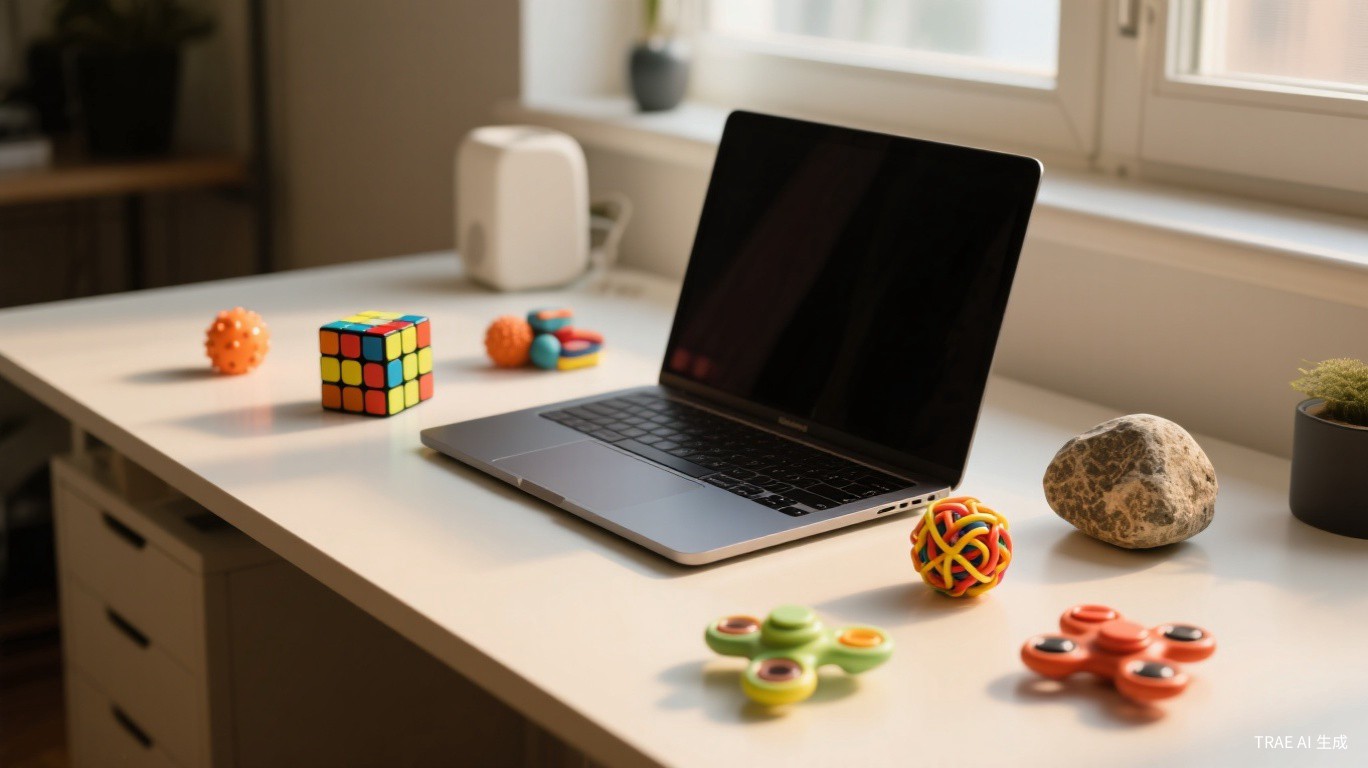
This is why fidget spinners, despite their popularity, are mediocre focus tools. The spinning motion is visually compelling. You want to watch it. Every time you glance at the spinner, you are pulling visual attention away from your work.
Compare that to a stress ball. You squeeze it without looking at it. Your visual attention stays on your work. The sensory input is entirely tactile and proprioceptive. No competition.
Principle 2: Autopilot Over Engagement
The best focus fidgets are ones your hands can manage without conscious thought. If you have to think about what your hands are doing, the fidget has become a task rather than a background activity.
This is the problem with complex fidget toys like Rubik's cubes or puzzle balls. They are engaging and satisfying, but they require problem-solving that pulls cognitive resources away from your primary task. Save the puzzles for break time.
Principle 3: Silent Over Audible
In shared environments, noise matters. A fidget that produces clicking, tapping, or rattling sounds will distract the people around you, which creates social friction that ultimately makes it harder for you to focus because you are worrying about being annoying.
Even in private, auditory fidgets can pull your attention. The sound becomes a stimulus that your brain has to process. Silent fidgets provide sensory input without adding to your auditory processing load.
Principle 4: Consistent Over Variable
A fidget that provides the same type of sensory input every time is better for focus than one that varies. Consistency allows your brain to habituate to the fidget, meaning it registers the input without consciously processing it. Variation forces your brain to keep paying attention to what the fidget is doing.
This is why a simple squeeze ball often outperforms a multi-feature fidget cube for pure focus purposes. The squeeze ball does the same thing every time. Your brain learns to ignore it while still benefiting from the sensory input.
The Three Categories of Focus Fidgets
Based on the research and my own experience testing hundreds of fidget tools, I divide focus fidgets into three categories based on the type of sensory input they provide.
Tactile Fidgets
These provide input through touch and texture. You feel them with your fingers and hands. Examples include stress balls, textured stones, putty, tangle toys, and textured rings.
Tactile fidgets are the best category for focus because they operate entirely in the background. They do not require visual attention. They are usually silent. And they provide the type of consistent, low-level sensory input that supports arousal regulation without competing for cognitive resources.
Best for: Reading, writing, studying, listening to lectures, attending meetings.
Proprioceptive Fidgets
These provide input through muscle tension and joint pressure. You feel them in your hands, wrists, and arms. Examples include grip trainers, resistance bands on chair legs, hand exercisers, and weighted objects.
Proprioceptive fidgets are particularly good for people who need strong sensory input to reach their optimal arousal level. The muscle engagement provides more intense feedback than tactile fidgets alone. They are also good for people who tend to be restless and need to move larger muscle groups.
Best for: Long meetings, tedious data work, situations where you need to stay seated for extended periods.
Auditory Fidgets
These provide input through sound. Examples include clicky pens, quiet clicker buttons, and worry coins that make a soft scraping sound.
Auditory fidgets are the most divisive category. Some people find rhythmic clicking or tapping extremely helpful for maintaining focus. Others find it distracting, and it is almost always distracting to the people around you. Use auditory fidgets only when you are alone or in an environment where the noise will not bother anyone.
Best for: Working alone, home office, private spaces.
Top 10 Fidget Toys for Focus
After years of research, testing, and talking to hundreds of people about their fidget habits, here are my ten recommended fidget tools for focus and concentration, ranked by effectiveness.
1. Therapy Putty
My top recommendation for a reason. Therapy putty is a silicone-based putty that comes in different resistance levels. You squeeze it, stretch it, roll it, and pinch it. The resistance provides proprioceptive feedback while the texture provides tactile input. It is completely silent. It requires zero visual attention. And it provides exactly the type of consistent, low-level motor activity that supports focus.
I use therapy putty during long research sessions. I keep a container on my desk and work it with my non-dominant hand while I write with my dominant hand. After a few minutes, I forget it is there, but my hands keep moving. That is the sweet spot.
Price: Eight to fifteen dollars. Noise level: Silent. Visual demand: None.
2. Stress Ball
The classic. A simple foam or gel ball that you squeeze repeatedly. Less versatile than therapy putty but even simpler to use. There is nothing to figure out. You squeeze it. Your brain habituates to it almost immediately, making it one of the fastest fidgets to become truly background.
Price: Three to ten dollars. Noise level: Silent. Visual demand: None.
3. Textured Worry Stone
A small stone with a thumb-sized indentation that you rub with your thumb. This is the most minimal fidget option and the one I recommend for people who think they do not need a fidget toy. It looks like nothing. It does nothing visible. But the rhythmic rubbing motion provides grounding tactile input that supports focus.
I keep a worry stone in my jacket pocket for conferences and presentations. I rub it while I am waiting to speak and it helps manage the pre-presentation jitters without anyone knowing.
Price: Five to fifteen dollars. Noise level: Silent. Visual demand: None.
4. Tangle Toy
A series of interconnected, rotating sections that you bend and twist in your hands. The motion is continuous and requires no thought. Your hands can manipulate a tangle toy on complete autopilot while your brain focuses elsewhere.
The tangle toy has a unique advantage over other tactile fidgets: it provides a sense of continuous motion without requiring repetitive squeezing. For people who find squeeze-based fidgets tiring after a while, the tangle toy offers a different type of motor engagement that is less fatiguing.
Price: Five to twelve dollars. Noise level: Nearly silent. Visual demand: Minimal.
5. Resistance Band on Chair Legs
This is a trick I learned from an occupational therapist. Loop a resistance band around the front legs of your chair. Rest your feet on the band and press against it throughout the day. It provides constant proprioceptive input to your legs and core without any visible movement.
This is particularly good for people who bounce their legs or tap their feet. Instead of the movement being random and sometimes disruptive to others, it becomes directed and quiet. The resistance also provides more sensory feedback than tapping alone, which means it is more effective at regulating arousal.
Price: Five to ten dollars for a set of bands. Noise level: Silent. Visual demand: None.
6. Infinity Cube
I include the infinity cube despite it being partially visual because the folding motion can become automatic with practice. Once your hands learn the folding pattern, you can operate an infinity cube without looking at it. The mechanical feedback from the hinges provides strong tactile input, and the weight of the cube adds proprioceptive feedback.
The infinity cube is my recommendation for people who find simple stress balls boring. It is more engaging than a squeeze ball but not so engaging that it becomes a distraction once you are used to it.
Price: Twelve to twenty-five dollars. Noise level: Quiet clicking from hinges. Visual demand: Low once you learn the pattern.
7. Spinner Ring
A wearable fidget that provides subtle tactile input through spinning. I recommend spinner rings specifically for focus because the spinning motion is controlled by your thumb and does not require visual attention. You can spin the ring while looking at a screen or a book without your eyes being drawn to it.
The advantage of a spinner ring over other fidgets is that you always have it with you. There is nothing to remember to bring. It is on your finger.
Price: Fifteen to sixty dollars. Noise level: Silent. Visual demand: None.
8. NeeDoh Stress Ball
NeeDoh products deserve a specific mention because they offer a different sensory experience than standard stress balls. The NeeDoh Nice Cube, for example, is a squishy cube filled with a non-toxic gel that deforms when you squeeze it and slowly returns to its original shape. The slow return creates a more satisfying and engaging squeeze compared to foam balls that spring back immediately.
The NeeDoh Dream Drop and NeeDoh Gummy Bear offer similar experiences in different shapes. The gel filling provides both tactile and proprioceptive feedback. They are silent and require no visual attention.
Price: Six to twelve dollars. Noise level: Silent. Visual demand: None.
9. Grip Trainer
A spring-loaded hand exerciser that provides strong proprioceptive feedback. You squeeze it against resistance, which engages the muscles in your hand, forearm, and to some extent your upper arm. The strong resistance makes this a good option for people who need intense sensory input to reach their focus zone.
I recommend grip trainers for people who find stress balls too mild. If you squeeze a stress ball and think "that is not enough," a grip trainer might be the right level of input for you.
Price: Ten to twenty dollars. Noise level: Quiet click on some models. Visual demand: None.
10. Textured Desk Object
This is a catch-all category that includes any small object with an interesting texture that you can keep on your desk and pick up when you need it. Smooth river stones, wooden carved objects, textured coasters, or even a piece of velvet fabric. The key is that it provides interesting tactile input that your fingers can explore while your mind works.
I have a small wooden cube with different textures carved into each face on my desk. I pick it up when I am thinking through a problem and put it down when I do not need it. There is no mechanism, no moving parts, just six different textures for my fingers to explore.
Price: Varies. Often free if you already have something suitable. Noise level: Silent. Visual demand: None.
Best Fidgets by Situation
Different work and study environments call for different fidget tools. Here is my breakdown by situation.
For Studying and Reading
When you are studying, your eyes and cognitive resources are fully occupied by the material. You need a fidget that operates entirely in the background.
Top picks: Therapy putty, stress ball, textured worry stone.
Avoid: Anything visual. Fidget spinners, infinity cubes, and anything with moving parts you want to watch.
For Work Meetings
Meetings require you to listen and sometimes speak while remaining seated and appearing attentive. Your fidget needs to be invisible to others and silent.
Top picks: Spinner ring, worry stone, resistance band under the desk, stress ball in your lap.
Avoid: Clicky fidgets, anything visible on the conference table, anything you have to look at.
For Computer Work
When you are working at a computer, your eyes are on the screen and your dominant hand is on the mouse. Your fidget should occupy your non-dominant hand.
Top picks: Therapy putty (non-dominant hand), stress ball, tangle toy, grip trainer between tasks.
Avoid: Anything that requires both hands, anything that makes noise in a shared office.
For Long Lectures or Presentations
You are sitting for an extended period, listening, and trying to retain information. Your fidget needs to be sustainable for the full duration without causing hand fatigue.
Top picks: Tangle toy, therapy putty (soft resistance), textured stone, resistance band on chair legs.
Avoid: Grip trainers (hand fatigue), anything that requires concentration.
For Creative Work
When you are writing, designing, or brainstorming, you want a fidget that supports divergent thinking without pulling focus from the creative flow.
Top picks: Therapy putty, infinity cube (once learned), textured desk object, tangle toy.
Avoid: Rhythmic clickers that might create a mental pattern that interferes with creative flow.
How to Introduce Fidgeting into Your Routine
If you have never used a fidget toy for focus before, here is how to start without it feeling forced or weird.
- Pick one fidget from the list above. Do not buy five. Start with one. Therapy putty or a stress ball is the safest starting point.
- Put it on your desk. Do not make a ceremony out of it. Just have it there.
- Pick it up when you notice your attention drifting. Do not force yourself to use it. Let it happen naturally. You will find yourself reaching for it during the boring parts of your day.
- Pay attention to whether it helps. After two weeks, ask yourself: Am I fidgeting less with other things? Am I more focused during long tasks? Am I less restless? If yes, the fidget is working. If no, try a different type.
- Do not fight the instinct. If your hands want to move, let them move. The whole point is to work with your body rather than against it.
Common Mistakes to Avoid
After years of studying fidgeting and talking to people about their experiences, here are the mistakes I see most often.
- Choosing a fidget that is too interesting. If you find yourself playing with the fidget instead of working, it is too engaging. Scale back to something simpler.
- Using a noisy fidget in shared spaces. You will annoy your coworkers and create social stress that undermines the focus benefit.
- Switching fidgets constantly. Give each fidget at least two weeks before deciding it does not work. Your brain needs time to habituate to the sensory input.
- Feeling embarrassed about fidgeting. The stigma around fidgeting is based on outdated ideas about attention. Moving your hands while you think is normal, natural, and according to the research, beneficial.
- Expecting a fidget to replace other focus strategies. Fidget tools work best as part of a broader approach that includes good sleep, regular exercise, proper nutrition, and structured work habits. A fidget toy is a tool, not a cure.
References and Further Reading
For those interested in the science behind this guide, the following research provides the foundation for the recommendations above.
The relationship between motor activity and attention has been studied extensively in the context of ADHD. Research by Sarver et al. published in the Journal of Abnormal Child Psychology demonstrated that children with ADHD who fidgeted more during cognitive tasks showed better performance on those tasks. This finding has been replicated in adult populations.
The arousal theory of attention, which underlies the recommendations in this guide, has its roots in the Yerkes-Dodson law from 1908, which describes the relationship between arousal and performance. More recent work has applied this framework specifically to ADHD and fidgeting behavior.
Work on proprioceptive input and self-regulation in occupational therapy provides additional support for the use of fidget tools, particularly those that provide strong tactile and muscle-engagement feedback.
The bottom line from the research is clear. Fidgeting is not a sign of inattention. For many people, it is a mechanism that supports attention. The right fidget toy, used in the right context, can make a meaningful difference in your ability to focus, study, and perform at work. The key is matching the fidget to the task, the environment, and your individual sensory needs.
Frequently Asked Questions
Do fidget toys actually help with focus?
Research indicates that fidget toys can improve focus for many people, particularly those with ADHD. The mechanism involves providing low-level motor stimulation that helps regulate arousal and attention levels. However, the effectiveness depends on choosing the right type of fidget for the task and the individual.
What is the best type of fidget toy for studying?
For studying, tactile fidgets that operate silently and require minimal attention tend to work best. Options like stress balls, textured stones, and quiet spinner rings provide background sensory input without pulling focus from the material. Avoid fidgets with visual or loud auditory components.
Can fidget toys help adults with ADHD focus at work?
Yes, many adults with ADHD report that fidget toys help them maintain focus during meetings, phone calls, and repetitive tasks. The key is finding a fidget that provides enough stimulation to satisfy the need for movement without being so engaging that it becomes a competing task.
Why does fidgeting help some people concentrate?
Fidgeting appears to help by optimizing arousal levels in the brain. People who fidget may have naturally lower baseline arousal, and the physical activity raises their arousal to an optimal level for attention. This is particularly relevant for individuals with ADHD who often struggle with under-stimulation.
What fidget toys should I avoid for focus?
Avoid fidgets that are visually stimulating like light-up toys, fidgets that make loud noises, and fidgets that require active problem-solving like puzzle cubes. These compete for cognitive resources rather than operating in the background. The best focus fidgets are ones your hands can manage on autopilot.